
:) :)
By alphabetical order img
Adam Albrecht Aivazovsky Ivan Konstantinovich Aladar Padly Allom Thomas Arthois Jacques d' Backer, Attributed to Jacob de Backhuysen Ludolph Balen I Hendrick van Barker of Bath Thomas Bassano Workshop of Jacopo Bassano II Francesco Baumgartner-Stoiloff Adolf (Constantin) Beer I. de Beerstraten Jan Abrahamsz Begeyn Abraham Jansz. Bella Stefano della Benois Nikolai Leontjewitsch Berchem Nicholaes Berckheyde Gerrit Adriaensz. Blaas Julius von Bloemaert Abraham Bloemaert Hendrick Blommaert Abraham Bogaert Hendrick Bogoliubov Alexei Petrovich Boilly Louis Léopold Boissieu Jean-Jacques de Boitmanis Ulrihs Bordone Paris Borisov Alexander Alekseevich Bossche Balthasar van den Bossoli Carlo Boudewijns Adraen Frans Bough Samuel Bray Jan de Brewer Henry Charles Bristow Edmund Broeck Elias van den Brueghel II & Abraham Govaerts Jan Bryullov Karl Pavlovich Burhardt Feodor Karlovich Caravaque Louis Carlone Giovanni Andrea Casanova Francesco Giuseppe Casteels Pauwels Castro Lorenzo A. Cats Jacob Charlemagne Adolphe Josefovich Charlemagne Joseph Josefovich Codde, Attributed to Pieter Jacobs Cole George Conca Sebastiano Conca Tomasso Maria Cooper Thomas Sidney Cotes, R.A. Francis Cotman Frederick George Craesbeeck Joos van Crampton Sir John Creara Sante Crespi Giuseppe Maria Crome John Cuyp Benjamin Gerritsz David Giovanni Decker Cornelis Gerritsz. Dmitriev-Kavkazsky Lev Evgrafovich Dobuzhinsky Mstislav Valerianovich Domenichini, The Master of the Langmatt Foundation Views Apollonio Facchinetti, called Droochsloot Joost Cornelisz Dubovskoy Nikolai Nikanorovich Dujardin Karel Duvieux Henri Ellis Tristram Everdingen Allaert van Faed R.S.A. John Ferg Franz de Paula Filippov Konstantin Nikolaevich Fischer Johann Georg Paul Foschi Francesco Franken Paul von French School Frost George Albert Gabashvili Gigo Gabbiani Antonio Domenico Gedlek Ludwig Gerlach Otto Goeree Jan Gordon Sir Thomas Edward Gorschelt Fedor Federovich Goyen Jan van Grimaldi, il Bolognese Giovanni Francesco Grimmer Abel Groningen Attributed to Jan Swart van Guardi Giacomo Guardi Gianantonio Hackaert Jan Hackert Jacob Philipp Harding James Duffield Harlamoff Alexei Alekseevich Havell William Heeremans Thomas Herring Jnr John Frederick Hilair Jean-Baptiste Hoet Gerard Horemans the Younger Jan Josef Ibbetson Julius Caesar Issupoff Alexei Vladimirovich Ivanov Ivan Andreevich Jankowsky Johann Wilhelm Jonson van Ceulen Cornelis Kalf Willem Kapustin Grigorij Ivanovich Karazin Nikolai Nikolaevich Keuninck the Elder Kerstiaen de Key Adriaen Thomasz. Key Attributed to Adriaen Thomasz. Klodt von Jurgensburg Baron Mikhail Konstantinovich Koerner Ernest Karl Eugen Kolesnikov Stepan Feodorovich Kollmann Karl Ivanovich Kondratenko Gavril Pavlovich Koninck Daniël de Kotov Nikolai Grigorievich Krachkovsky Josef Evstafievich Kravchenko Aleksey Ilyich Lagorio Lev Felixovich Lallemand Attributed to Jean-Baptiste Lanciano Polidoro de Renzi, called Polidoro da Landseer Charles Langer Olaf Viggo Peter Lattry Mikhail Pelopidovich Le Prince Jean-Baptiste Lee Frederick Richard Lingelbach Johannes Loo Carle van Loutherbourg, R.A. Philipe-Jacques de Lovatti Count Matteo Ludoviki Pierre Alexandrovich Parisot, called Luti Benedetto Maes Nicolaes Maevsky Mechislav Silvesterovich Maggiotto Domenico Maistre Count Xavier de Mak Paul Makovsky Konstantin Egorovich Makovsky Vladimir Egorovich Maliavin Philip Andreyevich Malyshev Nikolai Tarasievich Man Cornelis de Marieschi Circle of Michele Martos Nikita Ivanovich Massys Follower of Jan Mathauser Josef McConnell William Medina John Michallon Achille Etna Mieris Willem van Molenaer II Jan Molijn Pieter de Mols Robert Charles Gustave Laurens Momper Philippe de Momper II Joos de Montferrand After Auguste Ricard De Moor Carel de Morandi Attributed to Giovanni Maria Moucheron Frederik de Nash Frederick Nasmyth Alexander Neeffs The Elder Pieter Nesterov Mikhail Vasilevich Opitz Georg Emmanuel Orizzonte Jan Frans van Bloemen, called Orlov J Orlovsky Alexander Osipovich Ovsyannikov Sergey Osipovich Palmieri Pietro Giacomo Pantoja de la Cruz Juan Parme Jean-Antoine Julien, called Julien de Patersson Benjamin Pavlikevitch J Pellegrini Giovanni Antonio Pencz Attributed to George Perez, von Baron Josef Berres Pierre Jean-Baptist-Marie Pillement Jean-Baptiste Piola Domenico Pocock Nicholas Poelenburch Cornelis van Poplavsky Ludvig Ludvigovich Premazzi Luigi Ossipovich Preziosi Count Amadeo Prianishnikov Ivan Petrovich Repin Ilya Yefimovich Richards John Inigo Roepel Coenraet Rogier Camille Rombouts Salomon Romney George Roubaud Franz Alekseevich Ruysdael Salomon van Sabatelli Luigi Savitsky Georgy Konstantinovich Schmidt Genrikh Genrikhovich Schongauer, c.1500 Circle of Martin School Mid-Sixteenth Century Anglo-Netherlandish School, c.1500 South Netherlandish School, c.1529 Spanish School, c.1535 Flemish School, c.1580 Florentine School, Eighteenth Century North Italian School, Eighteenth Century Venetian School, Nineteenth Century Neapolitan School, Nineteenth Century Russian School, Seventeenth Century Florentine School, Twentieth Century Russian Schreyer Christian Adolf Schwarz Attributed to Christoph Sellaer Vincent Siberechts Jan Siemiradzki Henryk Simpson William Snyders and Studio Frans Sokolov Pyotr Petrovich Solimena Francesco Spranger Bartholomäus Stanfield George Clarkson Stone Frank Stoop Maerten Strechine Stephanie von Sudeikin Sergei Sustris Lambert Sverchkov Nicholai Egorovich Svetoslavsky Sergei Ivanovich Teniers II David Tiepolo Giovanni Battista Tintoretto Domenico Tomasso Toorenvliet Jacob Traballesi Bartolommeo Trutovsky Konstantin Alexandrovich Turner, R.A. Joseph Mallord William Tweenhuysen II Helmich von Uden Lucas van Valckenborch Lucas van Valentin Emile Vanvitelli Circle of Gaspar van Wittel, called Varley John Vasnetsov Apollinary Mikhailovich Velde Adriaen van de Velde Esaias van de Velde the Younger Willem van de Verburgh Dionijs Verschuring Hendrik Verschuur Wouter Vickers Alfred Gomersal Victors Jan Vignali Jacopo Visotsky Konstantin Semeonovich Vladimirov Ivan Alekseevich Vlieger Simon Jacobsz de Voloshin Maksimilian Aleksandrovich Vorobiev Sokrat Maksimovich Vorsterman Jan Vrancx Sebastian Ward James Watteau, called Watteau of Lille Louis-Joseph Webb James Weiss Joseph Andreas Wet I Jacob Willemsz. de Wheatley, R.A. Francis Wijnants Jan Wilson Alexander Wingfield James Digman Withoos Matthias Wouwerman Philips Wtewael Joachim Anthonisz. Wyck Thomas Yakovlev Aleksandr Evgen'evich Zeeman Reinier Nooms, called Zhukovsky Rudolf Kazimirovich Zommer Richard Karlovich Zucchi Attributed to Antonio
N

lexander Nasmyth

(Edinburgh 1758 - Edinburgh 1840)

img Biography

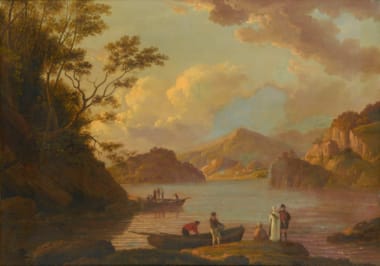
A View of Loch Lomond with Figures and Boats in the Foreground
img

A View of Loch Lomond with Figures and Boats in the Foreground

Biography

Alexander Nasmyth was a painter, illustrator, landscape gardener and engineer. He was educated for a career in architecture, but at an early age he showed artistic talent, and in 1773 he was apprenticed to James Cummyng (c. 1730–92), a house decorator and antiquarian. Nasmyth painted panels for carriages at Alexander Crichton’s coachworks and attended evening classes at the Trustees’ Academy. When Allan Ramsay visited Crichton in 1774, he was impressed with Nasmyth’s ability. Nasmyth subsequently accompanied Ramsay to his London studio where he continued his apprenticeship for four years.

Nasmyth returned to Edinburgh at the end of 1778 and soon obtained ample employment as a portrait painter. His earliest works, for example John Scott of Malleny (1781; Malleny House, Lothian, National Trust Scotland), followed Ramsay’s practice of showing the head and shoulders of the sitter against a plain background, but Nasmyth gradually liberated himself from the conventions of his master, and within a few years he was placing his figures within landscape settings, lavishing as much care on the landscape details as on the sitters. He painted Patrick Miller and his Children (1782; Dalswinton, Dumfries & Galloway, private collection) around the theme of a shooting-party, with the family set in their own parkland. Miller, a retired banker, discovered Nasmyth’s scientific capabilities and loaned him £500 with which to broaden his artistic education on the Continent.

Nasmyth arrived in Rome in April 1783. Views painted by him in later life from sketches made on the Continent suggest that he also visited the Bay of Naples, Bolsena, Ancona and Tivoli. His homeward route may be traced through pictures of Lake Lausanne, Lake Lucerne, Lake Geneva from the Jura Mountains and Haarlem. His sketches were the basis of many paintings by his children. He returned to Edinburgh at the end of 1784 and resumed painting portraits, the best known being of his close friend Robert Burns (1787; Edinburgh, National Gallery of Scotland). The Gordon Family at Braid (c. 1790; Cluny Castle, Grampian) represents the high point of Nasmyth’s portraiture. The handling of the dresses and attention to the details of the house in its landscape setting are particularly fine.

Nasmyth’s liberal politics and outspokenness on the glaring abuses of the government embarrassed his aristocratic patrons. Despite warnings that commissions would cease, he persisted in expressing his beliefs, even ‘refusing to paint their…faces, preferring instead the beautiful face of nature’. His portrait of Thomas, 7th Earl of Haddington and his Brothers (c. 1792; Mellerstain, Scottish Borders) remained half complete in Nasmyth’s studio at his death. Henry Raeburn’s dominance of portrait painting in Edinburgh during this period further encouraged Nasmyth to turn to landscape painting.

As early as 1788 Nasmyth described himself in the Edinburgh directories as ‘portrait and landscape painter’. His predominant theme was the Scottish landscape, usually containing an architectural feature often seen across water, the distance bathed in mist, for example Lugar Water (Aberdeen Art Gallery) and Loch Tay with Kenmore Bridge (1810; Tayside, private collection). A fine foreign view is the Ponte Molle on the Sylvan Side of Rome (1810; Manchester, City Art Gallery). In the 1820s he turned his attention to Edinburgh street scenes, recording fashions, daily activity and architecture, such as Princes Street, with the Royal Institution Building under Construction (1825; Edinburgh, National Galleries of Scotland). Edinburgh with the High Street and Lawnmarket (exhibited at the Royal Academy 1824; now held by the Royal Collection, Balmoral, Grampian) and its companion Shipping at Leith (exhibited at the Royal Academy 1824; now held by the City Chambers, Edinburgh) were probably painted to mark the visit of George IV to Edinburgh in 1822.

Nasmyth’s style appears to have been moulded principally on that of Claude Lorrain in arrangement, colour and mood, and on Jacob van Ruysdael in the handling of water, trees and foreground details. Rather than paint directly what he saw, Nasmyth would generally follow prevalent Picturesque theories as propounded by William Gilpin, first searching out the finest view and then editing or improving it to achieve a harmonious balance. He painted his pictures in the studio, working from small pencil sketches often made many years earlier. The paintings were then worked up from several layers of pigment and glazing to achieve a feeling of layered depth, the top leaves painted in minute and regular clusters of three or four. Throughout his life he used greens, browns and russet for the trees and foreground; pinks and browns for the paths and buildings; blue, grey–white, pinks and oranges for the skies, which were often the most colourful part of the composition. Nasmyth’s style, once formulated, displayed a remarkable consistency in both vision and technique throughout his career. From 1832 he suffered from gout and rheumatism, and the effects of old age rendered his later works less precise.

Admired during his lifetime as ‘the father of landscape painting in Scotland’, Nasmyth was later accused of repetitiveness. He frequently painted the same view several times, only varying the positions of the figures. Few of his works are signed, and because many ‘Nasmyths’ contain the hand of one or more of his talented children, care must be exercised in attributing lesser works to him, particularly as they vary considerably in quality. His best works, however, are distinguished by a rare interpretation of local weather conditions, which gives them an indefinable aura of romance, poetry and tranquillity. He sent his most ambitious pictures to London and also exhibited in Edinburgh, Manchester, Carlisle and Liverpool.

Nasmyth owned the upper floors of 47 York Place, which included a large studio, from 1799. As the Napoleonic Wars rendered the Continent unsafe for travel, Edinburgh assumed greater importance as a cultural centre, and Nasmyth responded to an increased demand for art classes. Among his pupils were David Wilkie, David Roberts, Clarkson Stanfield, William Allan, Andrew Robertson, Andrew Geddes, Hugh William Williams and John Thomson. Nasmyth’s teaching methods involved short instructive talks at the easel combined with copying objects, sometimes using the camera obscura. He did not take on apprentices in the conventional sense, and his relationships with pupils were informal.

Nasmyth was often called on to paint a large house or castle in its landscape: for example Castle Huntly (Dundee, McManus Galleries). At times he was employed to help his clients improve the landscape appearance of their estates by making the garden or park resemble his pictures of them. He made sketches and models to demonstrate how vistas might be opened up by judicious pruning, emphasizing the importance of preserving mature trees. He was often asked to select a suitable site for a new house, looking through the eyes of what Sir Uvedale Price termed the ‘architetto-pittore’, or to modernize an old castle. Between 1800 and 1810 he provided designs for follies, bridges, stable complexes and grand mansions, the latter including Taymouth Castle (Tayside), Dunglass House (Lothian), Loudoun Castle (Strathclyde), Dreghorn Castle (Lothian) and Rosneath (Dumbartonshire).

Nasmyth also produced the stock scenery for the principal Scottish theatres and those in Drury Lane in London. His scenery for Glasgow, which consisted of streets, houses, cottages, palaces, interiors and landscapes, ‘excited universal admiration’, according to David Roberts. Possibly as a result of the success in 1818 of the scenery for The Heart of Midlothian (sketches in Edinburgh, National Galleries of Scotland), Nasmyth was commissioned by Walter Scott through his publisher Archibald Constable to provide vignette engravings for the 1821 edition of the Waverley novels. In all Nasmyth contributed over 60 illustrations to Scott’s works.

Nasmyth had considerable talents as an engineer. He designed a tunnel under the Forth (Scotsman Magazine, 1807, pp. 189, 243) and made designs for bridges and bridge-building (Edinburgh, National Galleries of Scotland). The bow-and-string bridge and arch, used commonly for spanning rivers or the roofs of factories and railway stations, was his invention (1794), as was compression riveting (1816). He appears in John Graham Gilbert’s The Distinguished Men of Science of Great Britain Living in 1807/8 (London, National Portrait Gallery) beside Sir William Herschel, John Dalton, Isambard Kingdom Brunel, James Watt and Thomas Telford.
Nasmyth continued the family tradition of beautifying his native city. He designed St Bernard’s Well, the small temple over the Waters of Leith, and provided the original design for the Dean Bridge. He was keenly interested in the progress of the New Town, frequently making suggestions and models and discussing his ideas with the architects and builders. Princes Street from Hanover Street with the Foundation of the Royal Institution (exhibited at the Royal Academy 1826; now in Edinburgh, private collection) and Edinburgh from the Calton Hill (exhibited at the Royal Academy 1826; held in Glasgow, Clydesdale Bank Collection) show the progress of the New Town. Edinburgh from St Anthony’s Chapel (1832; Dalmeny House, Lothian) depicts in great detail the Old and completed New Towns side by side.

Collections

The work of Alexander Nasmyth is represented in the following collections: National Galleries of Scotland, Edinburgh; National Portrait Gallery, London; National Trust Scotland; City Art Gallery, Manchester; Royal Collection, Balmoral, Grampian; City Chambers, Edinburgh; Clydesdale Bank Collection, Glasgow; Dalmeny House, Lothian; McManus Galleries, Dundee; various private collections, amongst others.


img
Alexander Nasmyth (1758 - 1840)