School Florentine
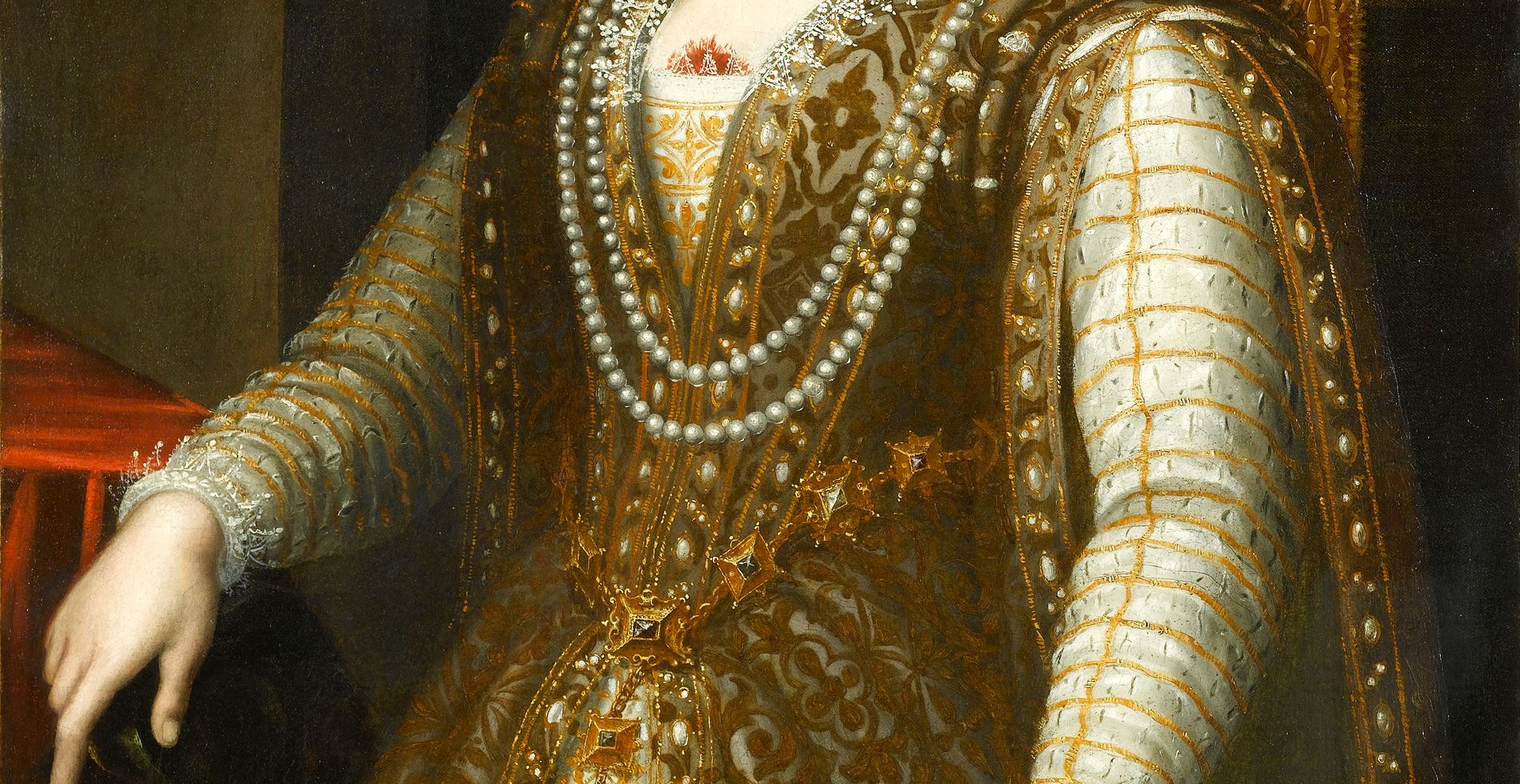
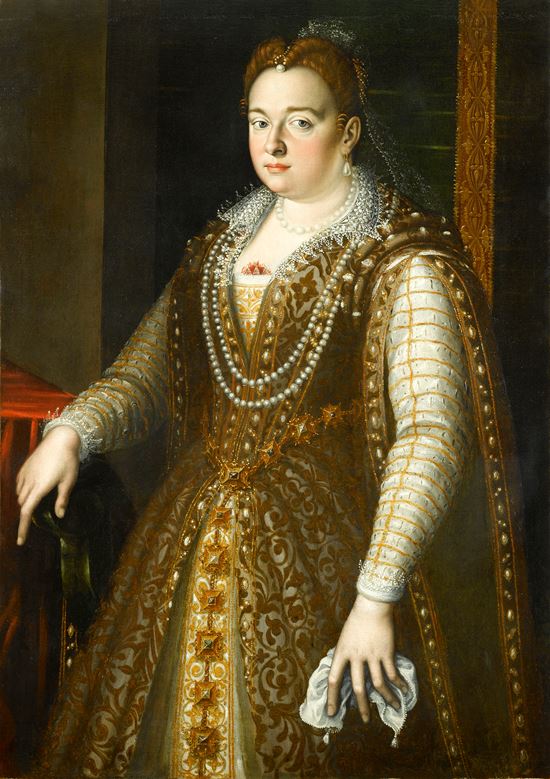
Portrait of Bianca Capello (1548 - 1587)
 contact
chool Florentine
Portrait of Bianca Capello (1548 - 1587)
oil on canvas
121 x 86.5 cm (47⅝ x 34 in)
 +44 20 7313 8040
This striking three-quarter-length portrait depicts Bianca Capello (1541-1587), one of the most celebrated women of the Cinquecento. Since her death the fame, scandal, and intrigue that surrounded her life have continued to fascinate historians and biographers, and this imposing portrait captures the wealth and majesty that helped make her such a compelling figure.
Bianca was born into a wealthy and powerful Venetian family, but at the age of fifteen caused scandal by running away and secretly marrying Pietro Bonaventuri, a Florentine accountant who had been working at the Salviati bank in Venice. Bianca’s father, Bartolomeo, was predictably furious and managed to have Bonaventuri banned from Venice, but his attempts to send his daughter to a monastery were resisted. The young couple settled in Florence where Bianca soon attracted the attention of Grand Prince Francesco de’ Medici (1541 – 1587), heir to the Tuscan throne. Bianca became Francesco’s mistress, despite his marriage to Joanna of Austria (1547-1578), and in 1572 Pietro was murdered ‘with the knowledge and, probably, approval of Francesco’.¹ Bianca and Francesco continued their relationship even when the latter became Grand Duke of Tuscany in 1574, and they had a son, Antonio, in 1576. The affair was common knowledge in Florence but was generally unpopular given the regard that Joanna of Austria was held, due to her devout nature and the political and economic alliances that the Hapsburg princess provided.² However, Joanna unexpectedly died in 1578, and two months later Francesco and Bianca married in secret.
A year later the couple remarried in public to great celebrations, and Bianca was officially Grand Duchess of Tuscany. Whilst her reputation did not particularly improve in Florence, in her native Venice Bianca was suddenly fêted. Her illustrious position and the unique role she swiftly began to play in the diplomatic relations between Tuscany and the Venetian Republic, resulted in her being represented as a symbol of Venetian virtue. Various festivities were held in Venice in her honour, her father and brother were knighted by the Doge and she was declared ‘daughter of the Republic’, an honour bestowed just once before, to Caterina Conaro, Queen of Cyprus (1454-1510). In keeping with the drama that dominated her life, even Bianca’s death was surrounded with intrigue. On the 20th October 1587, Bianca and Francesco died suddenly and unexpectedly following a banquet. The cause of death was unknown; many attributed it to malaria, whilst historically there were claims of poisoning, an explanation which has recently gained credence.³
The present work dates from the latter part of Bianca’s life, after she had become Grand Duchess. At that point her portrait was much in demand throughout Italy and there are numerous versions and variations of this type from the early 1580s.⁴ In these portraits Bianca is depicted with the exact same face, but her costume and accessories are varied. Karla Langedijk believes this type was originally established by Alessandro Allori (1535-1607), probably in 1578, and many of the known versions are given to him and his workshop.⁵ Allori certainly painted Bianca a number of times and in his Ricordi he mentions returning clothes he has borrowed from Bianca to help him paint her portrait.⁶ However, several other artists painted Bianca, using the facial type established by Allori, perhaps most notably Scipione Pulzone (c. 1550-1598). Pulzone’s original portrait is now missing, but a small bust-length version (today in the Kunsthistorisches Museum, Vienna), that he painted for the Venetian nobleman Francesco Bembo, caused a sensation when Bembo displayed it in Venice. On the day he received it, Bembo had to stop his wife from trying to kiss the painting, and in less than three months, 700 visitors came to his house to see it.⁷ The painting was taken to the Doge for a viewing⁸ and several copies were commissioned from, amongst others, Tintoretto, Bassano, Palma il Giovane and Veronese, although Bembo wrote that ‘few rather none of these painters will make it’.⁹
The present work is one of the Florentine depictions of Bianca Capello, deriving from Allori’s putative original. The crispness of the outlines of the facial features, and the smooth lines of paint that describe the tendrils in her hair and the hoop of her earring, suggest an artist in Allori’s circle. However, despite the undoubted quality of the present work, an exact attribution is still to be determined. Stylistically it is clear that the painting cannot be by Allori himself, and yet, as Elizabeth Pilliod has pointed out, it is far better than the work of other Florentine artists active during this period, such as Stefano Pieri (1542-1629) and Giovanni Bizzelli (1556-1612).¹⁰
Although, as already mentioned, there are numerous variations and derivations of the present work, it seems to be a unique version, rather than a direct copy. In many versions Bianca is seen sitting and, as befitted a Grand Duchess, is portrayed in a variety of luxurious costumes. The closest version is perhaps one known only through a photograph in Biblioteca Berenson, Florence. Although there are subtle changes to her costume and the items she holds in her hands, the compositions of the two paintings are very similar. However, the execution of our work is far superior, giving Bianca a greater sense of animation and psychological depth. In contrast to the precision with which the facial features are depicted, the costume in our picture is painted with free, expressive brushstrokes.
The opulence of Bianca’s clothing in the present work is in itself revealing, as they reflect how the Grand Duchess wished herself to be perceived. Elizabeth van Kessel points out that the strings of pearls and the carnation in her décolletage are both symbols of marriage and fertility.¹¹ These are details that reoccur in many of the different depictions of Bianca, and underline the legitimacy and respectability that her marriage gave to her. Van Kessel argues that although Bianca had recently been elevated to a position of Florentine power, our portrait actively promotes her Venetian heritage.¹² Both her hairstyle and her clothing are characteristically Venetian, their ostentatious grandeur is markedly different to the more subdued and sober outfits favoured by Florentine noblewomen. When discussing the Pulzone portrait, van Kessel says that Bianca ‘is not just shown as a princess, but specifally as a Venetian princess; as a daughter of that most Serene Republic’, an argument that equally applies to our version.¹³
Although the author of the present work is yet to be determined, the quality is undeniable. It effortlessly captures the grandeur and majesty of Bianca Capello, surely one of the most intriguing women of the Cinquecento. It reflects a sitter who has left the notoriety and scandal of her youth behind, and who now has the regal bearing of one of the most famous and celebrated women of her time.
¹ Kessel, E.J.M., The Social Lives of Paintings in Sixteenth-Century Venice, PhD dissertation, Leiden University, 2011, p.195.
² Musacchio, J.M., ‘Objects and Identity: Antonio de’Medici and the Casino at San Marco in Florence’ in The Renaissance World, ed. Martin, J.J. (The Routledge Worlds, New York, 2007), pp. 482-483.
³ For further discussion see Mari, F., Polettini, A., Lippi, D. & Berto, E., ‘The mysterious death of Francesco I de’ Medici and Bianca Cappello: an arsenic murder?’ in British Medical Journal, 333 (23-30 June 2006) pp. 1299-1301.
⁴ For a discussion of the different representations of Bianca Cappello, see Langedijk, K., The Portraits of the Medici: 15th-18th Centuries (Florence, 1981-1987), vol I., pp. 314-328.
⁵ Ibid., pp. 320-321.
⁶ Ibid., p. 314.
⁷ Kessel, E.J.M, ‘Staging Bianca Capello: Painting and Theatricality in Sixteenth- Century Venice’, in Theatricality in Early Modern Art and Architecture, ed. Caroline van Eck & Bussels. S. (Wiley-Blackwell, Oxford, 2011), p.84.
⁸ Ibid., p.85.
⁹ Kessel, The Social Lives of Paintings in Sixteenth-Century Venice, p.205.
¹⁰ Private Correspondence.
¹¹ Kessel, The Social Lives of Paintings in Sixteenth-Century Venice, p. 210.
¹² Ibid., pp. 210-211.
¹³ Ibid., p. 211.
Private collection, Vienna
Elizabeth J. M. van Kessel, The Social Lives of Paintings in Sixteenth-Century Venice, PhD dissertation, Leiden University, 2011, p. 209, fig. 82.



This striking three-quarter-length portrait depicts Bianca Capello (1541-1587), one of the most celebrated women of the Cinquecento. Since her death the fame, scandal, and intrigue that surrounded her life have continued to fascinate historians and biographers, and this imposing portrait captures the wealth and majesty that helped make her such a compelling figure.
Bianca was born into a wealthy and powerful Venetian family, but at the age of fifteen caused scandal by running away and secretly marrying Pietro Bonaventuri, a Florentine accountant who had been working at the Salviati bank in Venice. Bianca’s father, Bartolomeo, was predictably furious and managed to have Bonaventuri banned from Venice, but his attempts to send his daughter to a monastery were resisted. The young couple settled in Florence where Bianca soon attracted the attention of Grand Prince Francesco de’ Medici (1541 – 1587), heir to the Tuscan throne. Bianca became Francesco’s mistress, despite his marriage to Joanna of Austria (1547-1578), and in 1572 Pietro was murdered ‘with the knowledge and, probably, approval of Francesco’.¹ Bianca and Francesco continued their relationship even when the latter became Grand Duke of Tuscany in 1574, and they had a son, Antonio, in 1576. The affair was common knowledge in Florence but was generally unpopular given the regard that Joanna of Austria was held, due to her devout nature and the political and economic alliances that the Hapsburg princess provided.² However, Joanna unexpectedly died in 1578, and two months later Francesco and Bianca married in secret.
A year later the couple remarried in public to great celebrations, and Bianca was officially Grand Duchess of Tuscany. Whilst her reputation did not particularly improve in Florence, in her native Venice Bianca was suddenly fêted. Her illustrious position and the unique role she swiftly began to play in the diplomatic relations between Tuscany and the Venetian Republic, resulted in her being represented as a symbol of Venetian virtue. Various festivities were held in Venice in her honour, her father and brother were knighted by the Doge and she was declared ‘daughter of the Republic’, an honour bestowed just once before, to Caterina Conaro, Queen of Cyprus (1454-1510). In keeping with the drama that dominated her life, even Bianca’s death was surrounded with intrigue. On the 20th October 1587, Bianca and Francesco died suddenly and unexpectedly following a banquet. The cause of death was unknown; many attributed it to malaria, whilst historically there were claims of poisoning, an explanation which has recently gained credence.³
The present work dates from the latter part of Bianca’s life, after she had become Grand Duchess. At that point her portrait was much in demand throughout Italy and there are numerous versions and variations of this type from the early 1580s.⁴ In these portraits Bianca is depicted with the exact same face, but her costume and accessories are varied. Karla Langedijk believes this type was originally established by Alessandro Allori (1535-1607), probably in 1578, and many of the known versions are given to him and his workshop.⁵ Allori certainly painted Bianca a number of times and in his Ricordi he mentions returning clothes he has borrowed from Bianca to help him paint her portrait.⁶ However, several other artists painted Bianca, using the facial type established by Allori, perhaps most notably Scipione Pulzone (c. 1550-1598). Pulzone’s original portrait is now missing, but a small bust-length version (today in the Kunsthistorisches Museum, Vienna), that he painted for the Venetian nobleman Francesco Bembo, caused a sensation when Bembo displayed it in Venice. On the day he received it, Bembo had to stop his wife from trying to kiss the painting, and in less than three months, 700 visitors came to his house to see it.⁷ The painting was taken to the Doge for a viewing⁸ and several copies were commissioned from, amongst others, Tintoretto, Bassano, Palma il Giovane and Veronese, although Bembo wrote that ‘few rather none of these painters will make it’.⁹
The present work is one of the Florentine depictions of Bianca Capello, deriving from Allori’s putative original. The crispness of the outlines of the facial features, and the smooth lines of paint that describe the tendrils in her hair and the hoop of her earring, suggest an artist in Allori’s circle. However, despite the undoubted quality of the present work, an exact attribution is still to be determined. Stylistically it is clear that the painting cannot be by Allori himself, and yet, as Elizabeth Pilliod has pointed out, it is far better than the work of other Florentine artists active during this period, such as Stefano Pieri (1542-1629) and Giovanni Bizzelli (1556-1612).¹⁰
Although, as already mentioned, there are numerous variations and derivations of the present work, it seems to be a unique version, rather than a direct copy. In many versions Bianca is seen sitting and, as befitted a Grand Duchess, is portrayed in a variety of luxurious costumes. The closest version is perhaps one known only through a photograph in Biblioteca Berenson, Florence. Although there are subtle changes to her costume and the items she holds in her hands, the compositions of the two paintings are very similar. However, the execution of our work is far superior, giving Bianca a greater sense of animation and psychological depth. In contrast to the precision with which the facial features are depicted, the costume in our picture is painted with free, expressive brushstrokes.
The opulence of Bianca’s clothing in the present work is in itself revealing, as they reflect how the Grand Duchess wished herself to be perceived. Elizabeth van Kessel points out that the strings of pearls and the carnation in her décolletage are both symbols of marriage and fertility.¹¹ These are details that reoccur in many of the different depictions of Bianca, and underline the legitimacy and respectability that her marriage gave to her. Van Kessel argues that although Bianca had recently been elevated to a position of Florentine power, our portrait actively promotes her Venetian heritage.¹² Both her hairstyle and her clothing are characteristically Venetian, their ostentatious grandeur is markedly different to the more subdued and sober outfits favoured by Florentine noblewomen. When discussing the Pulzone portrait, van Kessel says that Bianca ‘is not just shown as a princess, but specifally as a Venetian princess; as a daughter of that most Serene Republic’, an argument that equally applies to our version.¹³
Although the author of the present work is yet to be determined, the quality is undeniable. It effortlessly captures the grandeur and majesty of Bianca Capello, surely one of the most intriguing women of the Cinquecento. It reflects a sitter who has left the notoriety and scandal of her youth behind, and who now has the regal bearing of one of the most famous and celebrated women of her time.
¹ Kessel, E.J.M., The Social Lives of Paintings in Sixteenth-Century Venice, PhD dissertation, Leiden University, 2011, p.195.
² Musacchio, J.M., ‘Objects and Identity: Antonio de’Medici and the Casino at San Marco in Florence’ in The Renaissance World, ed. Martin, J.J. (The Routledge Worlds, New York, 2007), pp. 482-483.
³ For further discussion see Mari, F., Polettini, A., Lippi, D. & Berto, E., ‘The mysterious death of Francesco I de’ Medici and Bianca Cappello: an arsenic murder?’ in British Medical Journal, 333 (23-30 June 2006) pp. 1299-1301.
⁴ For a discussion of the different representations of Bianca Cappello, see Langedijk, K., The Portraits of the Medici: 15th-18th Centuries (Florence, 1981-1987), vol I., pp. 314-328.
⁵ Ibid., pp. 320-321.
⁶ Ibid., p. 314.
⁷ Kessel, E.J.M, ‘Staging Bianca Capello: Painting and Theatricality in Sixteenth- Century Venice’, in Theatricality in Early Modern Art and Architecture, ed. Caroline van Eck & Bussels. S. (Wiley-Blackwell, Oxford, 2011), p.84.
⁸ Ibid., p.85.
⁹ Kessel, The Social Lives of Paintings in Sixteenth-Century Venice, p.205.
¹⁰ Private Correspondence.
¹¹ Kessel, The Social Lives of Paintings in Sixteenth-Century Venice, p. 210.
¹² Ibid., pp. 210-211.
¹³ Ibid., p. 211.
Private collection, Vienna
Elizabeth J. M. van Kessel, The Social Lives of Paintings in Sixteenth-Century Venice, PhD dissertation, Leiden University, 2011, p. 209, fig. 82.
You may also like