Willem Kalf
(Rotterdam 1619 - Amsterdam 1693)
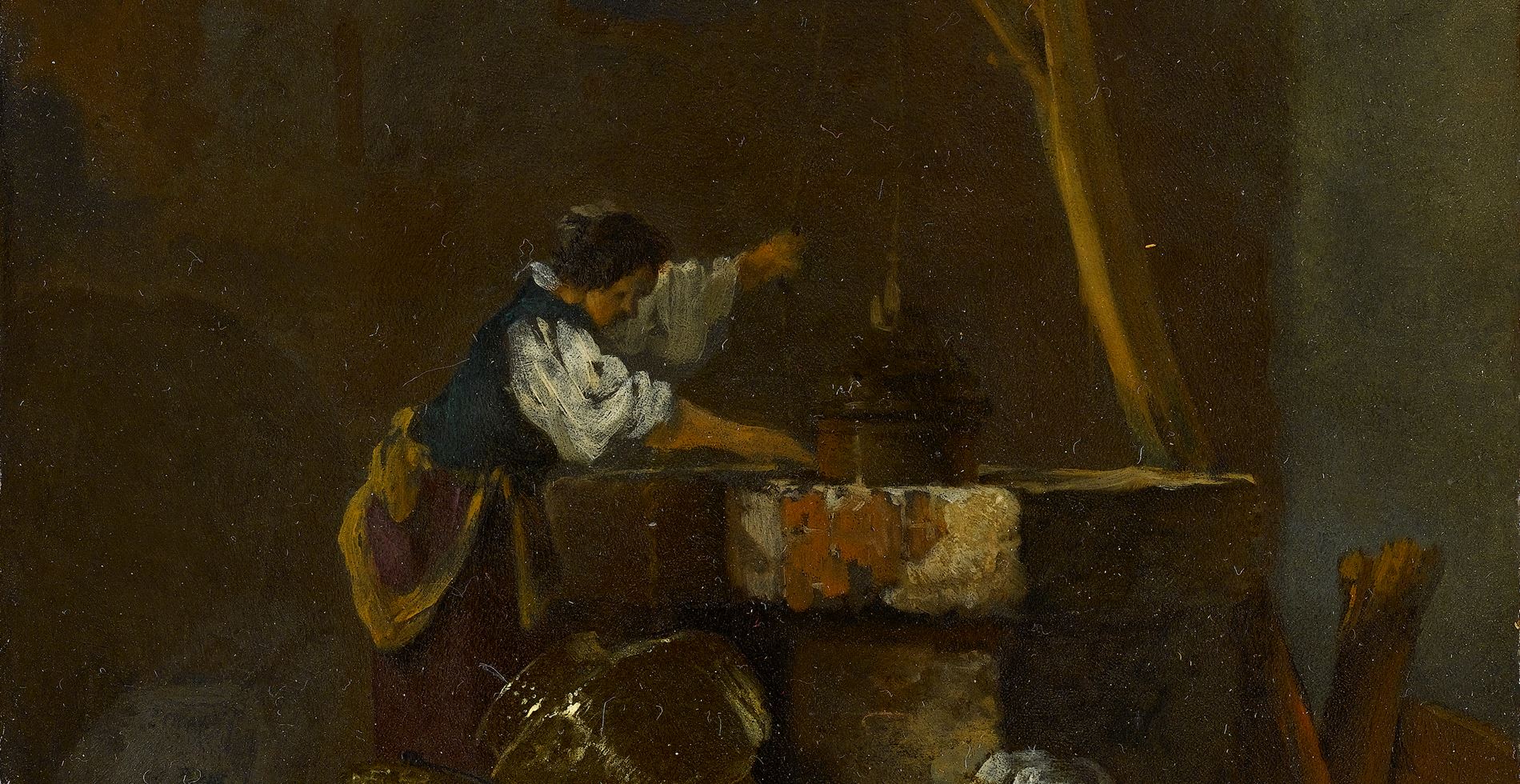
A Woman Pulling Water from a Well, a Pile of Vegetables at her Feet
 contact
illem Kalf
(Rotterdam 1619 - Amsterdam 1693)
A Woman Pulling Water from a Well, a Pile of Vegetables at her Feet
oil on copper
26.6 x 22.2 cm (10 1/2 x 8 3/4 in)
 +44 20 7313 8040
The present work has been dated to c. 1645 and is a fine example of Willem Kalf’s Parisian period. Set against a dark background, a peasant woman, her sleeves rolled up ready for work, is pulling water from a well. Next to the woman is a stone trough for laundry, and at her feet is a pile of vegetables and two large copper pans. This section, which is treated and composed like a still-life within a larger genre scene, is perhaps the outstanding feature of the work. The deep rich colouring of the pumpkin is expertly contrasted with the shimmering metal of the pots, as they sparkle in the faint light. This corner of the work hints at the skill and precision that characterise the dedicated still-lifes, which Kalf painted later in his career.
Kalf moved to Paris as a young man, and the present painting, like Barnyard with a Woman at a Well, (c. 1643-1644, Suermondt-Ludwig-Museum, Aachen) is typical of his work during that period. In fact these two farm interiors feature the same figure and setting, although the present copper panel has a more focused and intimate composition. Kalf painted mainly small-scale rustic interiors and still-lifes during this time, and the former are dominated by accumulations of buckets, pots, pans and vegetables, which are arranged as a still life in the foreground, whilst figures generally appear in slight obscurity in the background. Although painted in Paris, these works are more Flemish in character, and relate to the to the pictorial tradition exemplified at the time by David Teniers II (1610-1690). Kalf’s work during this period had a significant influence on French artists of the period, specifically those working in the circle of the Le Nain Brothers.
Kalf was born in Rotterdam in 1619 to a well-to-do merchant family. According to Arnold Houbraken (1660-1719), he trained in Haarlem with Hendrick Gerritsz Pot (c. 1580-1657), although there is no trace of Pot’s influence in Kalf’s early work, which is closer in style to the interiors of François Ryckhals (1609-1647). Kalf moved to Paris c. 1640, and was part of a circle of Flemish artists in St. Germain-des-Prés, and with works such as the present example he achieved great success. By the time he had returned to Rotterdam in 1646 he had also started to develop his large pronkstilleven of precious metals gleaming in dark interiors.
After brief spells in Rotterdam and Hoorn Kalf had moved to Amsterdam by 1653, and he remained in that city for the rest of his career. He started to inject more colour into his works which had their roots in the still-life tradition of banketjes or ‘little banquet piece’, but Kalf tended to focus on a limited number of luxurious objects: silver vessels, Chinese porcelain dishes or plates, expensive cut glass, gold goblets, Persian carpets, lobsters, oranges, peaches and the ubiquitous partially peeled lemons, which he arranged in differing positions according to a strictly axial compositional pattern.
Kalf lived until the age of seventy-three but appears to have painted less and less after 1663. Some of his works are considered amongst the finest accomplishments in Dutch still-life painting ‘and have earned Kalf a position in the first ranks of these specialists’.¹
We are grateful to Fred G. Meijer for confirming attribution of the present work to Kalf, following inspection of the original, and dating it c. 1645.
¹ Sutton, P., Dutch & Flemish Paintings: The Collection of Willem Baron van Dedem (Frances Lincoln Ltd., London, 2002), p.147.
Didier Aaron & Cie, Paris.



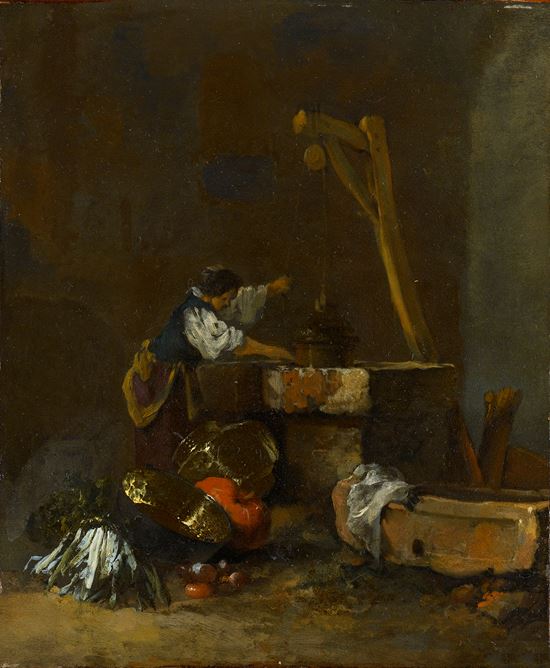
The present work has been dated to c. 1645 and is a fine example of Willem Kalf’s Parisian period. Set against a dark background, a peasant woman, her sleeves rolled up ready for work, is pulling water from a well. Next to the woman is a stone trough for laundry, and at her feet is a pile of vegetables and two large copper pans. This section, which is treated and composed like a still-life within a larger genre scene, is perhaps the outstanding feature of the work. The deep rich colouring of the pumpkin is expertly contrasted with the shimmering metal of the pots, as they sparkle in the faint light. This corner of the work hints at the skill and precision that characterise the dedicated still-lifes, which Kalf painted later in his career.
Kalf moved to Paris as a young man, and the present painting, like Barnyard with a Woman at a Well, (c. 1643-1644, Suermondt-Ludwig-Museum, Aachen) is typical of his work during that period. In fact these two farm interiors feature the same figure and setting, although the present copper panel has a more focused and intimate composition. Kalf painted mainly small-scale rustic interiors and still-lifes during this time, and the former are dominated by accumulations of buckets, pots, pans and vegetables, which are arranged as a still life in the foreground, whilst figures generally appear in slight obscurity in the background. Although painted in Paris, these works are more Flemish in character, and relate to the to the pictorial tradition exemplified at the time by David Teniers II (1610-1690). Kalf’s work during this period had a significant influence on French artists of the period, specifically those working in the circle of the Le Nain Brothers.
Kalf was born in Rotterdam in 1619 to a well-to-do merchant family. According to Arnold Houbraken (1660-1719), he trained in Haarlem with Hendrick Gerritsz Pot (c. 1580-1657), although there is no trace of Pot’s influence in Kalf’s early work, which is closer in style to the interiors of François Ryckhals (1609-1647). Kalf moved to Paris c. 1640, and was part of a circle of Flemish artists in St. Germain-des-Prés, and with works such as the present example he achieved great success. By the time he had returned to Rotterdam in 1646 he had also started to develop his large pronkstilleven of precious metals gleaming in dark interiors.
After brief spells in Rotterdam and Hoorn Kalf had moved to Amsterdam by 1653, and he remained in that city for the rest of his career. He started to inject more colour into his works which had their roots in the still-life tradition of banketjes or ‘little banquet piece’, but Kalf tended to focus on a limited number of luxurious objects: silver vessels, Chinese porcelain dishes or plates, expensive cut glass, gold goblets, Persian carpets, lobsters, oranges, peaches and the ubiquitous partially peeled lemons, which he arranged in differing positions according to a strictly axial compositional pattern.
Kalf lived until the age of seventy-three but appears to have painted less and less after 1663. Some of his works are considered amongst the finest accomplishments in Dutch still-life painting ‘and have earned Kalf a position in the first ranks of these specialists’.¹
We are grateful to Fred G. Meijer for confirming attribution of the present work to Kalf, following inspection of the original, and dating it c. 1645.
¹ Sutton, P., Dutch & Flemish Paintings: The Collection of Willem Baron van Dedem (Frances Lincoln Ltd., London, 2002), p.147.
Didier Aaron & Cie, Paris.
You may also like
(Rotterdam 1619 - Amsterdam 1693)
(Rotterdam 1619 - Amsterdam 1693)
(Rotterdam 1619 - Amsterdam 1693)