Lucas van Uden
(Antwerp 1595 - Antwerp 1672)
Landscape with a Cart Crossing a River
 contact
ucas van Uden
(Antwerp 1595 - Antwerp 1672)
Landscape with a Cart Crossing a River
oil on panel
85.1 x 126.4 cm (34½ x 49¾ in)
 +44 20 7313 8040
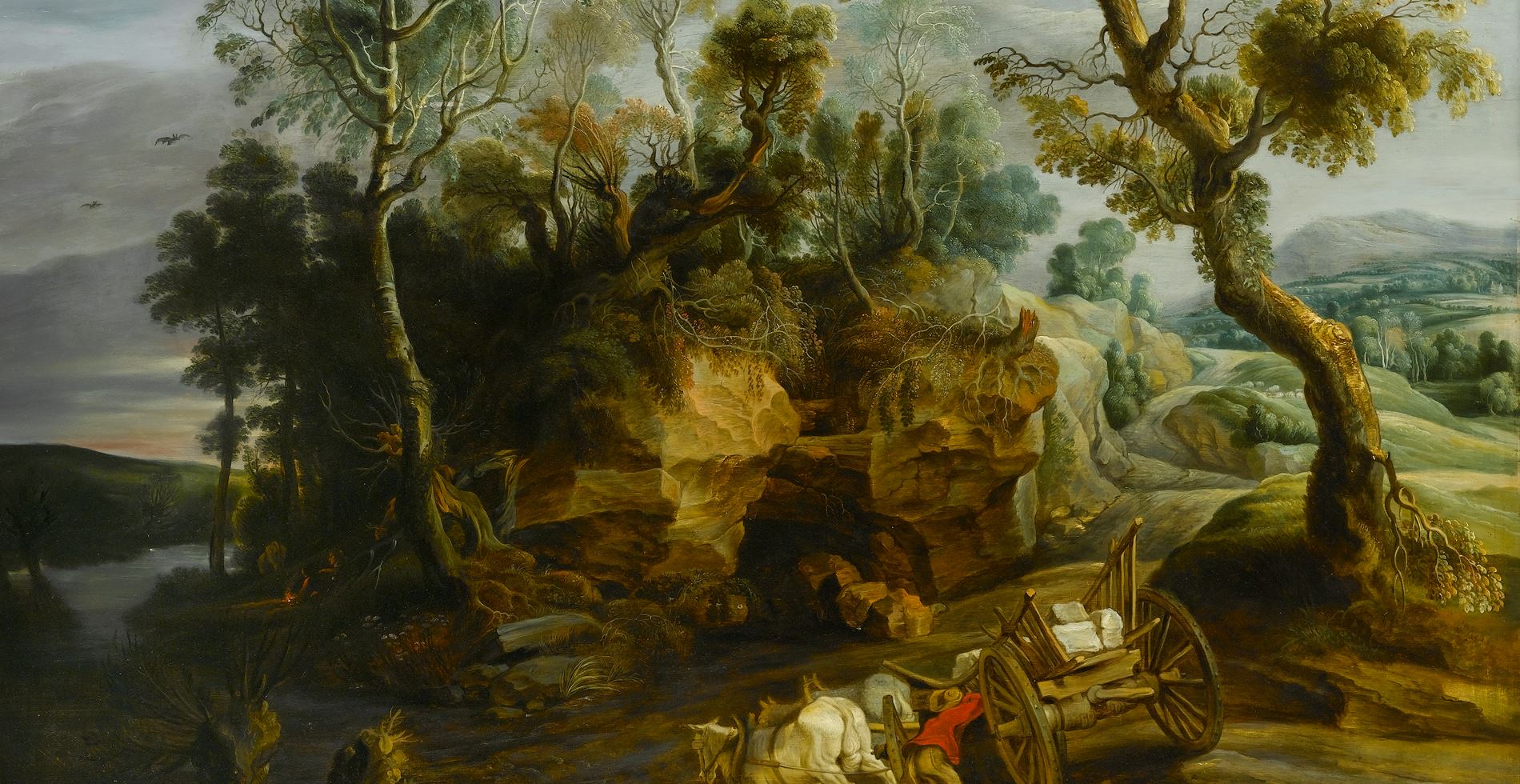
In Landscape with a Cart Crossing a River, Lucas van Uden depicts a horse-drawn cart, laden with huge stones, as it struggles across the uneven ground, a man straining as he tries to help the horses cross the river. The painting is dominated by the craggy cliff, overgrown with gnarled trees it splits the painting in two, with a dark river to the left hand side, and the brightly lit countryside on the right.
There is a distinct split in moods in van Uden’s work, with the left-hand side dark and forbidding, the river threatening the progress of the cart and two birds circling ominously overhead. Contrasted to this is the right hand side of the work where the pastoral landscape is bathed in a soft, warm light. Van Uden’s watercolours and etchings, for which he is most admired, display this same refined sense of light and mood.
Van Uden’s painting is a close repetition of a composition by Peter Paul Rubens’ Landscape with Stone Carriers. The major difference between the two paintings is that van Uden has eliminated the rider of the near horse. Although it has long been thought that van Uden was a member of Rubens’ workshop and provided landscape backgrounds for some of the master’s compositions, there is no documentary evidence to support the assumption. Nonetheless, he clearly knew Rubens’ work very well, for he copied several other compositions, as well as borrowing specific motifs from the older artist. Van Uden’s Ulysses and Nausicaa, is another example derived from a Rubens composition, now housed in the Pitti Palace Florence. As in the present work, van Uden uses a more intense palate than the Rubens’ version, which is drenched in a soft golden light. However, compositionally van Uden closely follows the prototype.
Van Uden was the son of the town painter of Antwerp. Around 1627 he joined Antwerp’s Guild of Saint Luke as a ‘master’s son’. He travelled along the Rhine from 1644 to 1646 but spent most of his career in Antwerp.
Van Uden’s great talent was for observing nature. According to Arnold Houbraken (1660-1719) , Van Uden took walks in the country in the early mornings, solely to sketch. His landscapes tended to be relatively traditional in terms of composition, but notable for the skilful manipulation of light, demonstrated in the present work. He usually painted his own figures, although occasionally he collaborated with David Teniers II (1610-1690).
As discussed van Uden is closely associated with Rubens, although it is uncertain whether they ever worked together. However, in addition to whole compositions, such as the present work, van Uden incorporated many Rubensian elements into his own landscapes , such as a woman carrying a round jug on her head, cows at a watering place, and stylistic devices like foreground trees lit from behind, with yellow-orange-tipped branches.
Otto Schatzker, Vienna, before the Second World War;
Oscar Klein, Vienna by 1935,
thence by descent to the previous American owner.
G. Glück, Die Landschaften des Peter Paul Rubens, Vienna 1945, p. 56, no. 7 (as probably by L. Van Uden);
W. Adler, Corpus Rubenianum Ludwig Burchard, Part XVIII, vol. 1, Landscapes and Hunting Scenes, under cat. no. 19, p. 80, copy 4.



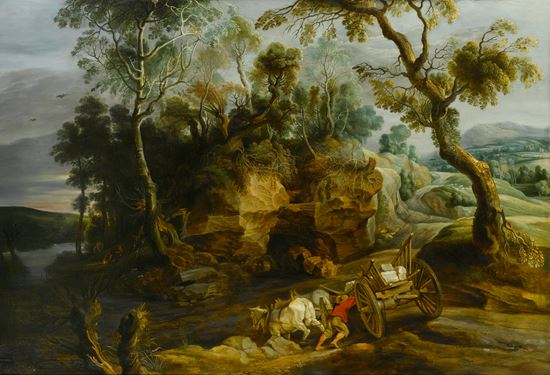
In Landscape with a Cart Crossing a River, Lucas van Uden depicts a horse-drawn cart, laden with huge stones, as it struggles across the uneven ground, a man straining as he tries to help the horses cross the river. The painting is dominated by the craggy cliff, overgrown with gnarled trees it splits the painting in two, with a dark river to the left hand side, and the brightly lit countryside on the right.
There is a distinct split in moods in van Uden’s work, with the left-hand side dark and forbidding, the river threatening the progress of the cart and two birds circling ominously overhead. Contrasted to this is the right hand side of the work where the pastoral landscape is bathed in a soft, warm light. Van Uden’s watercolours and etchings, for which he is most admired, display this same refined sense of light and mood.
Van Uden’s painting is a close repetition of a composition by Peter Paul Rubens’ Landscape with Stone Carriers. The major difference between the two paintings is that van Uden has eliminated the rider of the near horse. Although it has long been thought that van Uden was a member of Rubens’ workshop and provided landscape backgrounds for some of the master’s compositions, there is no documentary evidence to support the assumption. Nonetheless, he clearly knew Rubens’ work very well, for he copied several other compositions, as well as borrowing specific motifs from the older artist. Van Uden’s Ulysses and Nausicaa, is another example derived from a Rubens composition, now housed in the Pitti Palace Florence. As in the present work, van Uden uses a more intense palate than the Rubens’ version, which is drenched in a soft golden light. However, compositionally van Uden closely follows the prototype.
Van Uden was the son of the town painter of Antwerp. Around 1627 he joined Antwerp’s Guild of Saint Luke as a ‘master’s son’. He travelled along the Rhine from 1644 to 1646 but spent most of his career in Antwerp.
Van Uden’s great talent was for observing nature. According to Arnold Houbraken (1660-1719) , Van Uden took walks in the country in the early mornings, solely to sketch. His landscapes tended to be relatively traditional in terms of composition, but notable for the skilful manipulation of light, demonstrated in the present work. He usually painted his own figures, although occasionally he collaborated with David Teniers II (1610-1690).
As discussed van Uden is closely associated with Rubens, although it is uncertain whether they ever worked together. However, in addition to whole compositions, such as the present work, van Uden incorporated many Rubensian elements into his own landscapes , such as a woman carrying a round jug on her head, cows at a watering place, and stylistic devices like foreground trees lit from behind, with yellow-orange-tipped branches.
Otto Schatzker, Vienna, before the Second World War;
Oscar Klein, Vienna by 1935,
thence by descent to the previous American owner.
G. Glück, Die Landschaften des Peter Paul Rubens, Vienna 1945, p. 56, no. 7 (as probably by L. Van Uden);
W. Adler, Corpus Rubenianum Ludwig Burchard, Part XVIII, vol. 1, Landscapes and Hunting Scenes, under cat. no. 19, p. 80, copy 4.
You may also like
(Antwerp 1595 - Antwerp 1672)
(Antwerp 1595 - Antwerp 1672)
(Antwerp 1595 - Antwerp 1672)