John Faed R.S.A.
(Gatehouse of Fleet 1819 - Gatehouse of Fleet 1902)
Posthumus and Imogen
 contact
ohn Faed R.S.A.
(Gatehouse of Fleet 1819 - Gatehouse of Fleet 1902)
Posthumus and Imogen
signed and dated ‘Faed 65’ (lower left)
oil on canvas
87.6 x 59 cm (34½ x 23¼ in)
 +44 20 7313 8040
And, sweetest, fairest,
As I my poor self did exchange for you,
To your so infinite loss, so in our trifles
I still win of you: for my sake wear this;
It is a manacle of love; I'll place it
Upon this fairest prisoner.
- Postumus Leonatus, Cymbeline, Act I, Scene I
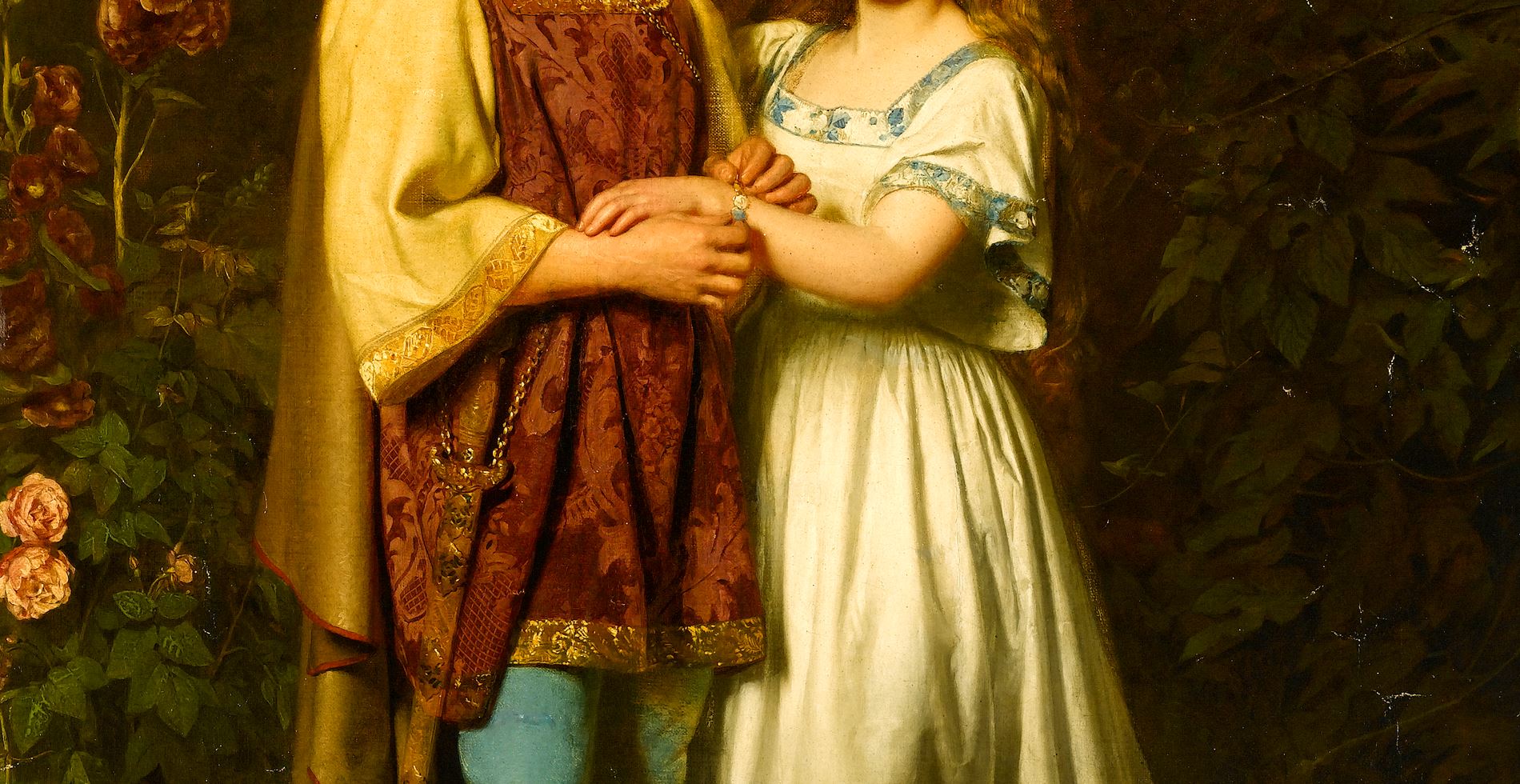
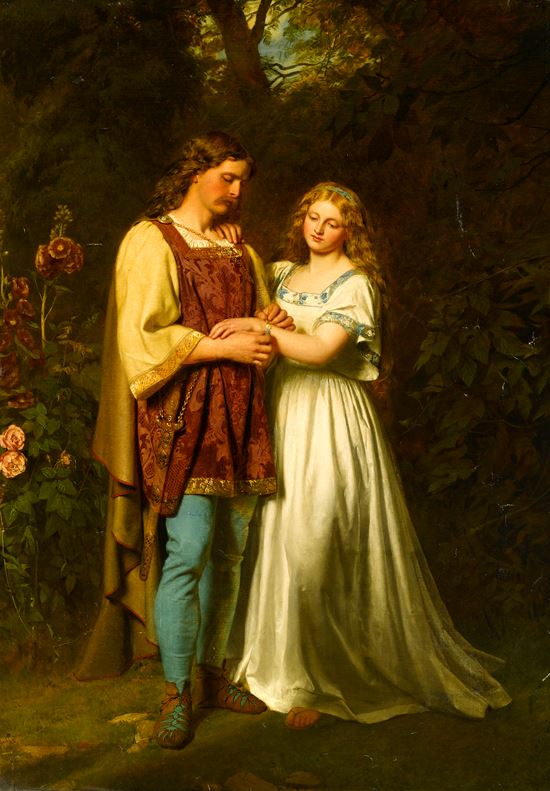
John Faed frequently exhibited subjects from William Shakespeare (1564-1616) during his career, and here he depicts a scene from Shakespeare’s romantic tragedy, Cymbeline. The play’s protagonist Posthumus, a lowborn gentleman, is brought up by King Cymbeline alongside his daughter Imogen, with whom he falls in love. Posthumus marries Imogen and in doing so is banished by Cymbeline from his Kingdom. This scene depicts the moment in which Posthumus presents Imogen with a bracelet before departing, the bracelet itself later plays a crucial part in the development of the play.
Stylistically, this painting is influenced by the work of the Pre-Raphaelites. The Pre-Raphaelite Brotherhood was a secret society formed in 1848 by seven young artists in London with the aim of creating a new British art. The Brotherhood emulated the art of late medieval and early Renaissance Europe until the time of Raphael and was a deliberate and marked step against contemporary academic painting.
Characterised by minute detailing, the Pre-Raphaelites depicted subjects of a noble, religious or moral nature and Shakespeare’s plays became a great source of inspiration for them, in particular Sir John Everett Millais (1829-96). The Pre-Raphaelites keenly observed the botanical accuracy of the natural world and adopted a bright palette of colours that recalled the work of medieval artists and luminous manuscripts. The technical precision in Posthumus and Imogen is equally remarkable, as is the brilliance and varied choice of palette, all demonstrating Faed’s experience and talent as a painter of miniatures earlier in his life.
Faed was born in Kirkcudbright, Galloway in Scotland in 1819. Faed’s artistic skill was evident at a very young age, exhibiting his first miniature painting at the age of just ten. Faed was primarily a self-taught artist and, at the young age of eleven, he painted a miniature series of local Galloway aristocrats. He painted miniatures until the age of twenty one, when he settled in Edinburgh where he attended the Trustees’ Academy. From the end of the 1840s he started exhibiting at the Royal Scottish Academy to which he was elected an Associate in 1847 and to full membership four years later. In total he exhibited over 240 works at the Royal Scottish Academy in his lifetime, as well as exhibiting works at the Royal Academy. In 1864 he moved with his brother Thomas, also a successful artist, to London staying there until 1880. However, his love of Galloway meant that he spent much of his time between London and his house in Gatehouse of Fleet, Galloway.
Bought from the artist by Morby in 1865 (£300).
Mary McKerrow, The Faeds: A Biography, (Edinburgh, 1982,) p. 147.



And, sweetest, fairest,
As I my poor self did exchange for you,
To your so infinite loss, so in our trifles
I still win of you: for my sake wear this;
It is a manacle of love; I'll place it
Upon this fairest prisoner.
- Postumus Leonatus, Cymbeline, Act I, Scene I
John Faed frequently exhibited subjects from William Shakespeare (1564-1616) during his career, and here he depicts a scene from Shakespeare’s romantic tragedy, Cymbeline. The play’s protagonist Posthumus, a lowborn gentleman, is brought up by King Cymbeline alongside his daughter Imogen, with whom he falls in love. Posthumus marries Imogen and in doing so is banished by Cymbeline from his Kingdom. This scene depicts the moment in which Posthumus presents Imogen with a bracelet before departing, the bracelet itself later plays a crucial part in the development of the play.
Stylistically, this painting is influenced by the work of the Pre-Raphaelites. The Pre-Raphaelite Brotherhood was a secret society formed in 1848 by seven young artists in London with the aim of creating a new British art. The Brotherhood emulated the art of late medieval and early Renaissance Europe until the time of Raphael and was a deliberate and marked step against contemporary academic painting.
Characterised by minute detailing, the Pre-Raphaelites depicted subjects of a noble, religious or moral nature and Shakespeare’s plays became a great source of inspiration for them, in particular Sir John Everett Millais (1829-96). The Pre-Raphaelites keenly observed the botanical accuracy of the natural world and adopted a bright palette of colours that recalled the work of medieval artists and luminous manuscripts. The technical precision in Posthumus and Imogen is equally remarkable, as is the brilliance and varied choice of palette, all demonstrating Faed’s experience and talent as a painter of miniatures earlier in his life.
Faed was born in Kirkcudbright, Galloway in Scotland in 1819. Faed’s artistic skill was evident at a very young age, exhibiting his first miniature painting at the age of just ten. Faed was primarily a self-taught artist and, at the young age of eleven, he painted a miniature series of local Galloway aristocrats. He painted miniatures until the age of twenty one, when he settled in Edinburgh where he attended the Trustees’ Academy. From the end of the 1840s he started exhibiting at the Royal Scottish Academy to which he was elected an Associate in 1847 and to full membership four years later. In total he exhibited over 240 works at the Royal Scottish Academy in his lifetime, as well as exhibiting works at the Royal Academy. In 1864 he moved with his brother Thomas, also a successful artist, to London staying there until 1880. However, his love of Galloway meant that he spent much of his time between London and his house in Gatehouse of Fleet, Galloway.
Bought from the artist by Morby in 1865 (£300).
Mary McKerrow, The Faeds: A Biography, (Edinburgh, 1982,) p. 147.
You may also like
(Gatehouse of Fleet 1819 - Gatehouse of Fleet 1902)
(Gatehouse of Fleet 1819 - Gatehouse of Fleet 1902)
(Gatehouse of Fleet 1819 - Gatehouse of Fleet 1902)