Ivan Ivanovich Shishkin
(Elabuga 1832 - St. Petersburg 1898)
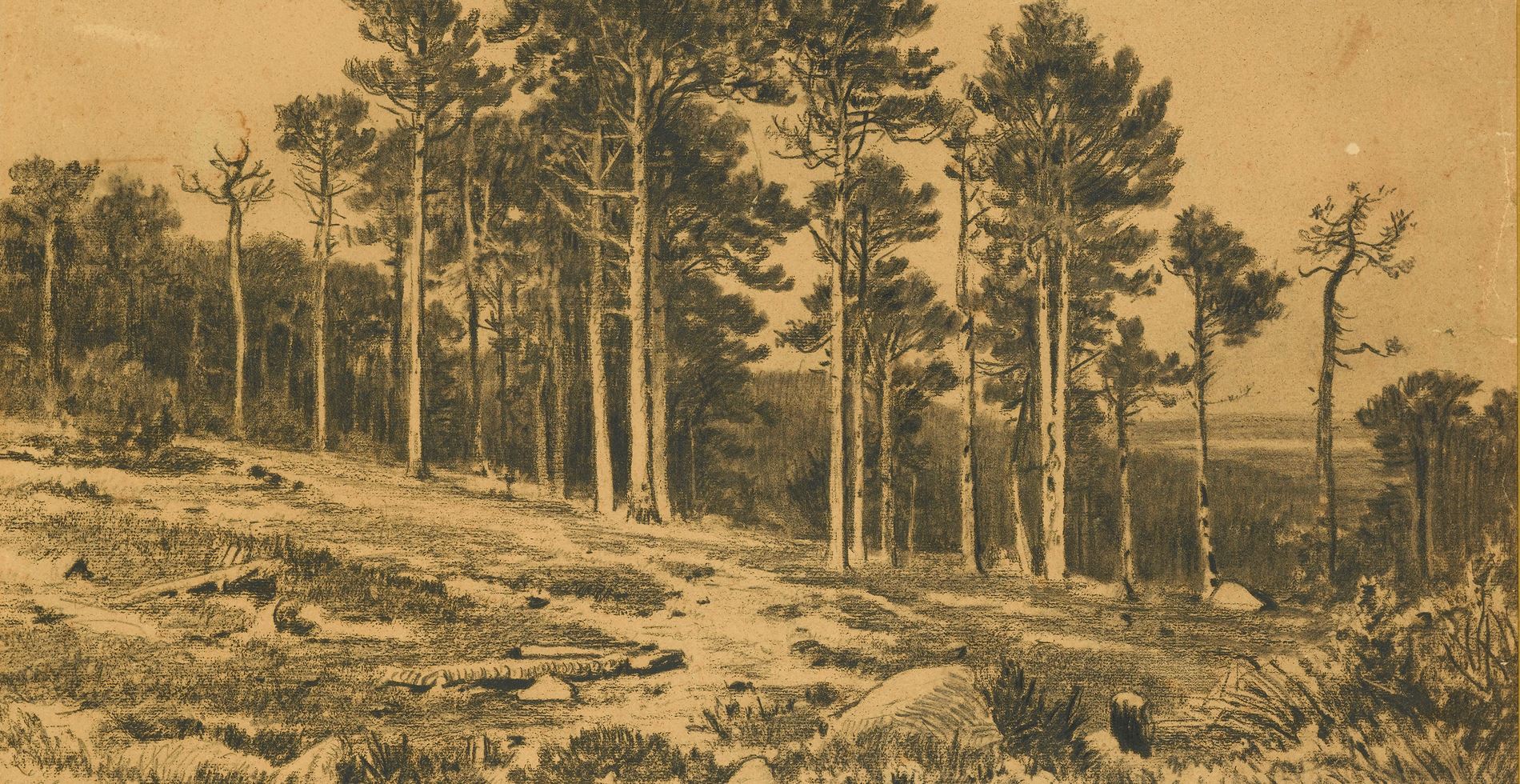
Edge of a Pine Forest
 contact
van Ivanovich Shishkin
(Elabuga 1832 - St. Petersburg 1898)
Edge of a Pine Forest
signed in Cyrillic and dated ‘1884’ (lower right)
graphite and charcoal on paper
32.5 x 46.5 cm (12¾ x 18¼ in)
 +44 20 7313 8040
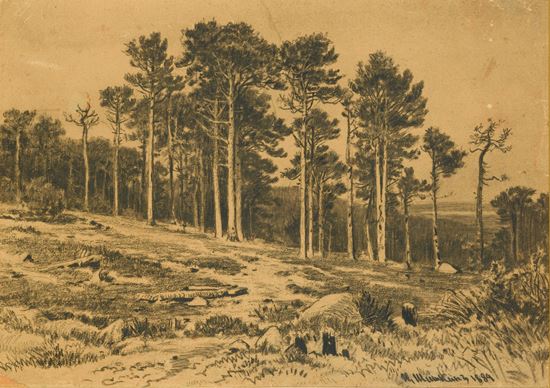
Edge of a Pine Forest is an excellent example of Ivan Ivanovich Shishkin’s later depictions of forests. The naturalistic treatment and glimpses of unfolding vistas are characteristic of his style during the 1880s. Shishkin considered drawing to be an important branch of art. At this time the lines in his drawings are elastic and mobile, sometimes flowing, light and wavy, whilst at other times resilient and strong. He uses black lead in a light, free style but his pencil strokes are more animated and varied. Shishkin used a combination of pencil, charcoal, graphite and white chalk, which allowed him to achieve softer effects and a finer gradation of tone. Over forty years of artistic activity, Shishkin produced hundreds of paintings, numerous studies and drawings, and a large number of engravings. Many of these concerned forests and trees. An oil painting created a few years after the drawing, Forest in Mordvinovo (1891, State Museum and Exhibition Centre ROSIZO, Moscow), illustrates Shishkin’s use of an alternative medium to treat the same subject. Shishkin considered studies to be an integral part of the creative process, based on continual observation and reflection. The resulting level of detail does not detract from the unity of the picture, but contributes to a carefully thought out composition and the harmonious use of light colours.
The present drawing was executed by Shishkin specifically for a project to demonstrate the potential of photogravure as a printing method. Photogravure can reproduce the detail and continuous tones of a photograph, and the publisher A. I. Beggrov released two albums of Shishkin’s chalk drawings using this method, in 1884 and 1885. As can be seen in another example from the series, Bleak Winter, one can see how effective this method was in conveying the detail and subtlety of Shishkin’s technique. According to a letter from Shishkin, the original drawings also became Beggrov’s property, and were possibly exhibited as a set in 1885.1
Shishkin studied at the Moscow School of Painting, Sculpture and Architecture (1852-56) and also at the Imperial Academy of Arts (1856-60). Having been awarded the Academy’s great gold medal, the artist received the means to travel abroad. In 1864 he continued his education at the Düsseldorf Academy of Arts; indeed his mature work is similar to that of the Düsseldorf School of landscape painting. Having completed his journey abroad, Shishkin returned to St. Petersburg where he met artists such as Ilya Yefimovich Repin and Isaac Ilyich Levitan (1860-1900), who were attuned to democratic ideals and aware of contemporary problems. The country at this time witnessed the spreading of the emancipation movement, the growth of critical thought, and an increased awareness of the need for decisive changes in political and economic spheres, and also in art and culture. The principles of materialist aesthetics, enunciated by the leaders of the revolutionary democrats, Nikolai Chernyshevsky (1829-1889) and Nikolai Dobroliubov (1836-1861), were of special importance in this ideological struggle. The role of art developed: rather than act simply as a mirror of the surrounding world, art began to be perceived as a means of transforming it.
Based on these ideas the Russian Realist artist group ‘The Wanderers’, or the Peredvizhniki, was founded. The ideological leader of the movement was Ivan Nikolaevich Kramskoi (1837-1887), a powerful and highly influential figure in Russian art, both through his paintings and his art reviews. He had attended the Imperial Academy of Arts but left before graduating in what was to be called ‘The Rebellion of the Fourteen’. Kramskoi was one of the main instigators of the rebellion which was a reaction against Academic tradition. In an accolade to Shishkin, Kramskoi wrote, in 1872, ‘Shishkin simply amazes us by his ability, doing two or three studies a day, and such complex ones, too… out there face to face with nature, he is in his element, he is bold, clever and unhesitant; out there he knows everything… he is by himself a school… a milestone in the evolution of the Russian landscape.’
1 Letter from Shishkin to Beggrov, written from St. Petersburg in 1885, reproduced in Ivan Ivanovich Shishkin, World of the Artist: Correspondence. Diary. Contemporaries of the Artist, ed. I. Shuvalov (Leningrad, 1978), no. 136.
Commissioned from the artist by A.I. Beggrov, 1884;
Private Collection, France.
I.I. Shiskin: Charcoal Drawings Reproduced by Way of Phototype, vol. I, (A.I. Beggrov, St. Petersburg, 1884), no. 2.



Edge of a Pine Forest is an excellent example of Ivan Ivanovich Shishkin’s later depictions of forests. The naturalistic treatment and glimpses of unfolding vistas are characteristic of his style during the 1880s. Shishkin considered drawing to be an important branch of art. At this time the lines in his drawings are elastic and mobile, sometimes flowing, light and wavy, whilst at other times resilient and strong. He uses black lead in a light, free style but his pencil strokes are more animated and varied. Shishkin used a combination of pencil, charcoal, graphite and white chalk, which allowed him to achieve softer effects and a finer gradation of tone. Over forty years of artistic activity, Shishkin produced hundreds of paintings, numerous studies and drawings, and a large number of engravings. Many of these concerned forests and trees. An oil painting created a few years after the drawing, Forest in Mordvinovo (1891, State Museum and Exhibition Centre ROSIZO, Moscow), illustrates Shishkin’s use of an alternative medium to treat the same subject. Shishkin considered studies to be an integral part of the creative process, based on continual observation and reflection. The resulting level of detail does not detract from the unity of the picture, but contributes to a carefully thought out composition and the harmonious use of light colours.
The present drawing was executed by Shishkin specifically for a project to demonstrate the potential of photogravure as a printing method. Photogravure can reproduce the detail and continuous tones of a photograph, and the publisher A. I. Beggrov released two albums of Shishkin’s chalk drawings using this method, in 1884 and 1885. As can be seen in another example from the series, Bleak Winter, one can see how effective this method was in conveying the detail and subtlety of Shishkin’s technique. According to a letter from Shishkin, the original drawings also became Beggrov’s property, and were possibly exhibited as a set in 1885.1
Shishkin studied at the Moscow School of Painting, Sculpture and Architecture (1852-56) and also at the Imperial Academy of Arts (1856-60). Having been awarded the Academy’s great gold medal, the artist received the means to travel abroad. In 1864 he continued his education at the Düsseldorf Academy of Arts; indeed his mature work is similar to that of the Düsseldorf School of landscape painting. Having completed his journey abroad, Shishkin returned to St. Petersburg where he met artists such as Ilya Yefimovich Repin and Isaac Ilyich Levitan (1860-1900), who were attuned to democratic ideals and aware of contemporary problems. The country at this time witnessed the spreading of the emancipation movement, the growth of critical thought, and an increased awareness of the need for decisive changes in political and economic spheres, and also in art and culture. The principles of materialist aesthetics, enunciated by the leaders of the revolutionary democrats, Nikolai Chernyshevsky (1829-1889) and Nikolai Dobroliubov (1836-1861), were of special importance in this ideological struggle. The role of art developed: rather than act simply as a mirror of the surrounding world, art began to be perceived as a means of transforming it.
Based on these ideas the Russian Realist artist group ‘The Wanderers’, or the Peredvizhniki, was founded. The ideological leader of the movement was Ivan Nikolaevich Kramskoi (1837-1887), a powerful and highly influential figure in Russian art, both through his paintings and his art reviews. He had attended the Imperial Academy of Arts but left before graduating in what was to be called ‘The Rebellion of the Fourteen’. Kramskoi was one of the main instigators of the rebellion which was a reaction against Academic tradition. In an accolade to Shishkin, Kramskoi wrote, in 1872, ‘Shishkin simply amazes us by his ability, doing two or three studies a day, and such complex ones, too… out there face to face with nature, he is in his element, he is bold, clever and unhesitant; out there he knows everything… he is by himself a school… a milestone in the evolution of the Russian landscape.’
1 Letter from Shishkin to Beggrov, written from St. Petersburg in 1885, reproduced in Ivan Ivanovich Shishkin, World of the Artist: Correspondence. Diary. Contemporaries of the Artist, ed. I. Shuvalov (Leningrad, 1978), no. 136.
Commissioned from the artist by A.I. Beggrov, 1884;
Private Collection, France.
I.I. Shiskin: Charcoal Drawings Reproduced by Way of Phototype, vol. I, (A.I. Beggrov, St. Petersburg, 1884), no. 2.
You may also like
(Elabuga 1832 - St. Petersburg 1898)
(Elabuga 1832 - St. Petersburg 1898)
(Elabuga 1832 - St. Petersburg 1898)