Henryk Siemiradzki
(Pečenegi, Ukraine 1843 - Strzalkowo, Poland 1902)
The Rape of the Sabine Women
 contact
enryk Siemiradzki
(Pečenegi, Ukraine 1843 - Strzalkowo, Poland 1902)
The Rape of the Sabine Women
signed in Cyrillic (lower right) and dated '27 August 1867' (lower right)
pen and ink heightened with bodycolour over pencil on paper
54 x 76 cm (21½ x 30 in)
 +44 20 7313 8040
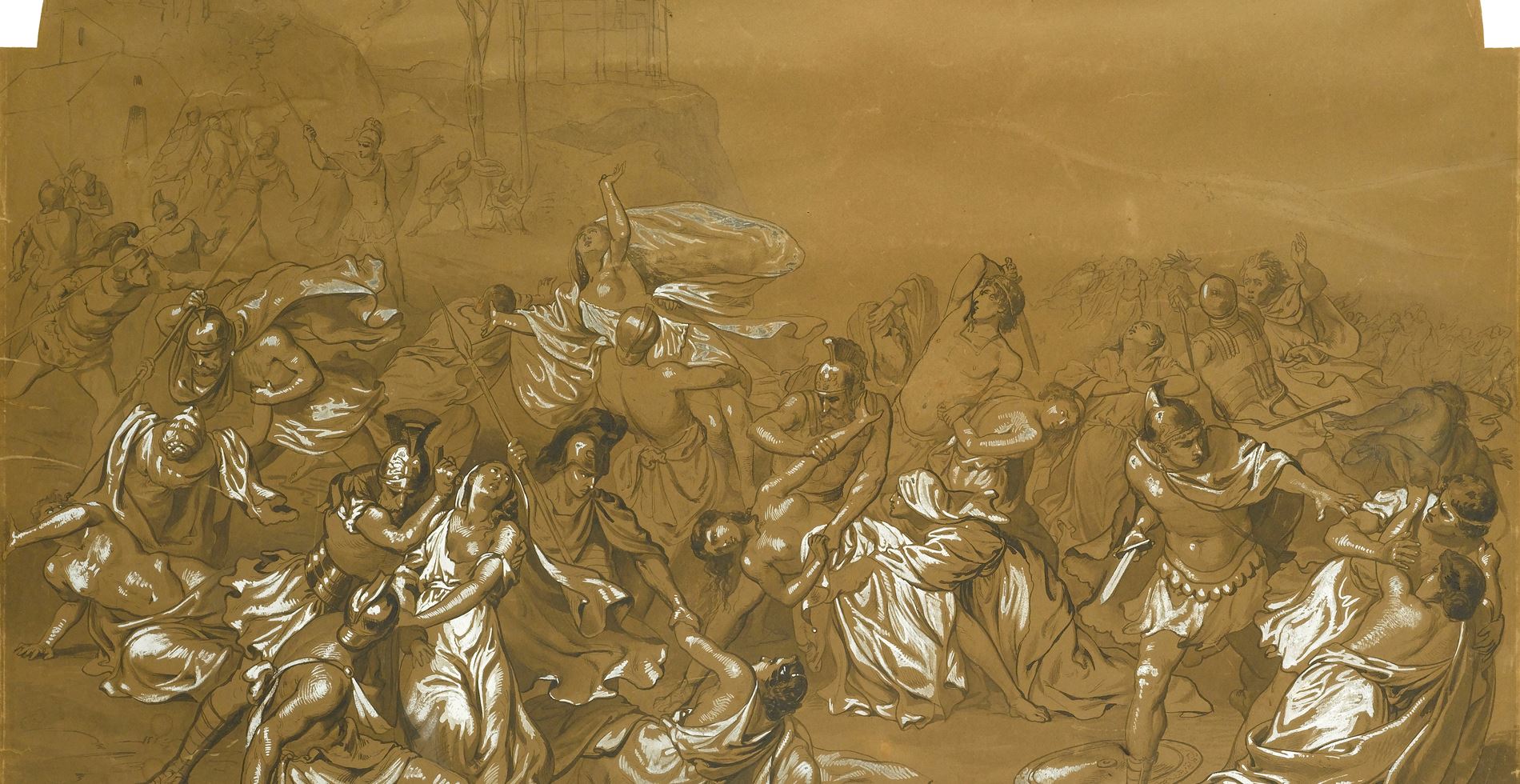
In this drawing Henryk Siemiradzki has presented an intense and dramatic interpretation of the story of The Rape of the Sabine Women. The Rape (in this context, rape means abduction) is supposed to have occurred in the early history of Rome, not long after its foundation by Romulus. Romulus and his troops sought to find wives in order to start new families and ensure the future growth of the population. They looked to the Sabines or Sabini, an Italic tribe who lived in the central Apennine region of ancient Italy, but negotiations proved futile as the Sabines feared the emergence of a rival society and so refused to allow their women to marry the Romans. Consequently Romulus and his followers planned to abduct the Sabine women. He arranged a magnificent festival to which he invited the inhabitants of neighbouring settlements, including the Sabines, with their wives and children. During the festivities, at a given signal, the young men of Rome broke into the crowd and, choosing only the unmarried maidens of the Sabines, carried them off. According to Plutarch (c.46-120AD) ‘they did not commit this rape wantonly, but with a design purely of forming alliance with their neigbours by the greatest and surest bond.’¹
In The Rape of the Sabine Women Siemiradzki has chosen to depict the frenzy of the abduction. The emotions of the various figures are plain to see; the determination of the Romans, the desperate defiance of the Sabine men, and the helpless anguish of the women. Every figure has been closely studied and individualised, so that the viewer becomes engrossed by the individual conflicts within the larger melee. Standing in the background Romulus can be seen, sword brandished as he directs his men.
Siemiradzki was a painter of grandiose history pictures, usually depicting ancient Roman, Russian and biblical subjects. Although The Rape of the Sabine Women is an early work, it is comparable to the large-scale oil paintings which brought him such success. For example in Svyatoslav’s Warriors in the Battle of Silistria, Siemiradski has again captured the frenzy and struggle of battle, as women and children fight with the soldiers. Both works demonstrate the traditional Classicism which Siemiradzki practised throughout his career. Amidst the tumult each figure has been carefully and individually depicted, the narrative theatrically and clearly conveyed, and the composition tightly planned and balanced across the foreground.
Siemiradzki was born into a Polish family and originally studied as a scientist, although he had a longstanding interest in painting. He eventually abandoned his scientific career and moved to St. Petersburg to study painting at the Imperial Academy of Arts between the years 1864 and 1870; he adhered to his training as a Classical History painter throughout his career. Upon graduating, he was awarded a scholarship which enabled him to travel and study throughout Europe for six years.
In 1873 he received the title of Academician of the Imperial Academy of Arts for his painting Christ and a Sinner based on a verse by Aleksey Konstantinovich Tolstoy (1817-1875) and he established his reputation as a History painter of monumental scale, although he also depicted smaller genre scenes set in Italianate landscapes with antiquated ruins. Siemiradzki also worked on frescoes for the Cathedral of Christ the Saviour in Moscow. The Rape of the Sabine Women is a fascinating early work which demonstrates why he was to enjoy such success later in life.
¹ Plutarch, Lives II, 14 and 19.



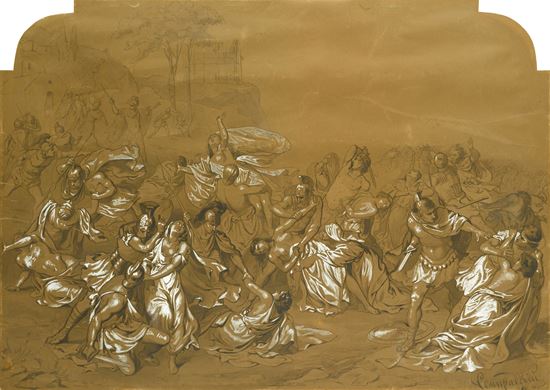
In this drawing Henryk Siemiradzki has presented an intense and dramatic interpretation of the story of The Rape of the Sabine Women. The Rape (in this context, rape means abduction) is supposed to have occurred in the early history of Rome, not long after its foundation by Romulus. Romulus and his troops sought to find wives in order to start new families and ensure the future growth of the population. They looked to the Sabines or Sabini, an Italic tribe who lived in the central Apennine region of ancient Italy, but negotiations proved futile as the Sabines feared the emergence of a rival society and so refused to allow their women to marry the Romans. Consequently Romulus and his followers planned to abduct the Sabine women. He arranged a magnificent festival to which he invited the inhabitants of neighbouring settlements, including the Sabines, with their wives and children. During the festivities, at a given signal, the young men of Rome broke into the crowd and, choosing only the unmarried maidens of the Sabines, carried them off. According to Plutarch (c.46-120AD) ‘they did not commit this rape wantonly, but with a design purely of forming alliance with their neigbours by the greatest and surest bond.’¹
In The Rape of the Sabine Women Siemiradzki has chosen to depict the frenzy of the abduction. The emotions of the various figures are plain to see; the determination of the Romans, the desperate defiance of the Sabine men, and the helpless anguish of the women. Every figure has been closely studied and individualised, so that the viewer becomes engrossed by the individual conflicts within the larger melee. Standing in the background Romulus can be seen, sword brandished as he directs his men.
Siemiradzki was a painter of grandiose history pictures, usually depicting ancient Roman, Russian and biblical subjects. Although The Rape of the Sabine Women is an early work, it is comparable to the large-scale oil paintings which brought him such success. For example in Svyatoslav’s Warriors in the Battle of Silistria, Siemiradski has again captured the frenzy and struggle of battle, as women and children fight with the soldiers. Both works demonstrate the traditional Classicism which Siemiradzki practised throughout his career. Amidst the tumult each figure has been carefully and individually depicted, the narrative theatrically and clearly conveyed, and the composition tightly planned and balanced across the foreground.
Siemiradzki was born into a Polish family and originally studied as a scientist, although he had a longstanding interest in painting. He eventually abandoned his scientific career and moved to St. Petersburg to study painting at the Imperial Academy of Arts between the years 1864 and 1870; he adhered to his training as a Classical History painter throughout his career. Upon graduating, he was awarded a scholarship which enabled him to travel and study throughout Europe for six years.
In 1873 he received the title of Academician of the Imperial Academy of Arts for his painting Christ and a Sinner based on a verse by Aleksey Konstantinovich Tolstoy (1817-1875) and he established his reputation as a History painter of monumental scale, although he also depicted smaller genre scenes set in Italianate landscapes with antiquated ruins. Siemiradzki also worked on frescoes for the Cathedral of Christ the Saviour in Moscow. The Rape of the Sabine Women is a fascinating early work which demonstrates why he was to enjoy such success later in life.
¹ Plutarch, Lives II, 14 and 19.
You may also like
(Pečenegi, Ukraine 1843 - Strzalkowo, Poland 1902)
(Pečenegi, Ukraine 1843 - Strzalkowo, Poland 1902)
(Pečenegi, Ukraine 1843 - Strzalkowo, Poland 1902)