Giovanni Antonio Pellegrini
(Venice 1675 - Venice 1741)
Young Hannibal Swears Enmity to Rome
 contact
iovanni Antonio Pellegrini
(Venice 1675 - Venice 1741)
Young Hannibal Swears Enmity to Rome
oil on canvas
71 x 94 cm (27⅞ x 37 in)
 +44 20 7313 8040
‘When I come to age, I shall pursue the Romans with fire and sword and enact again the doom of Troy. The gods shall not stop my career, nor the treaty that bars the sword, neither the lofty Alps nor the Tarpeian rock. I swear to this purpose by the divinity of our native god of war, and by the shade of Elissa.’
- Silius Italicus, Punica, Book I, 114-119
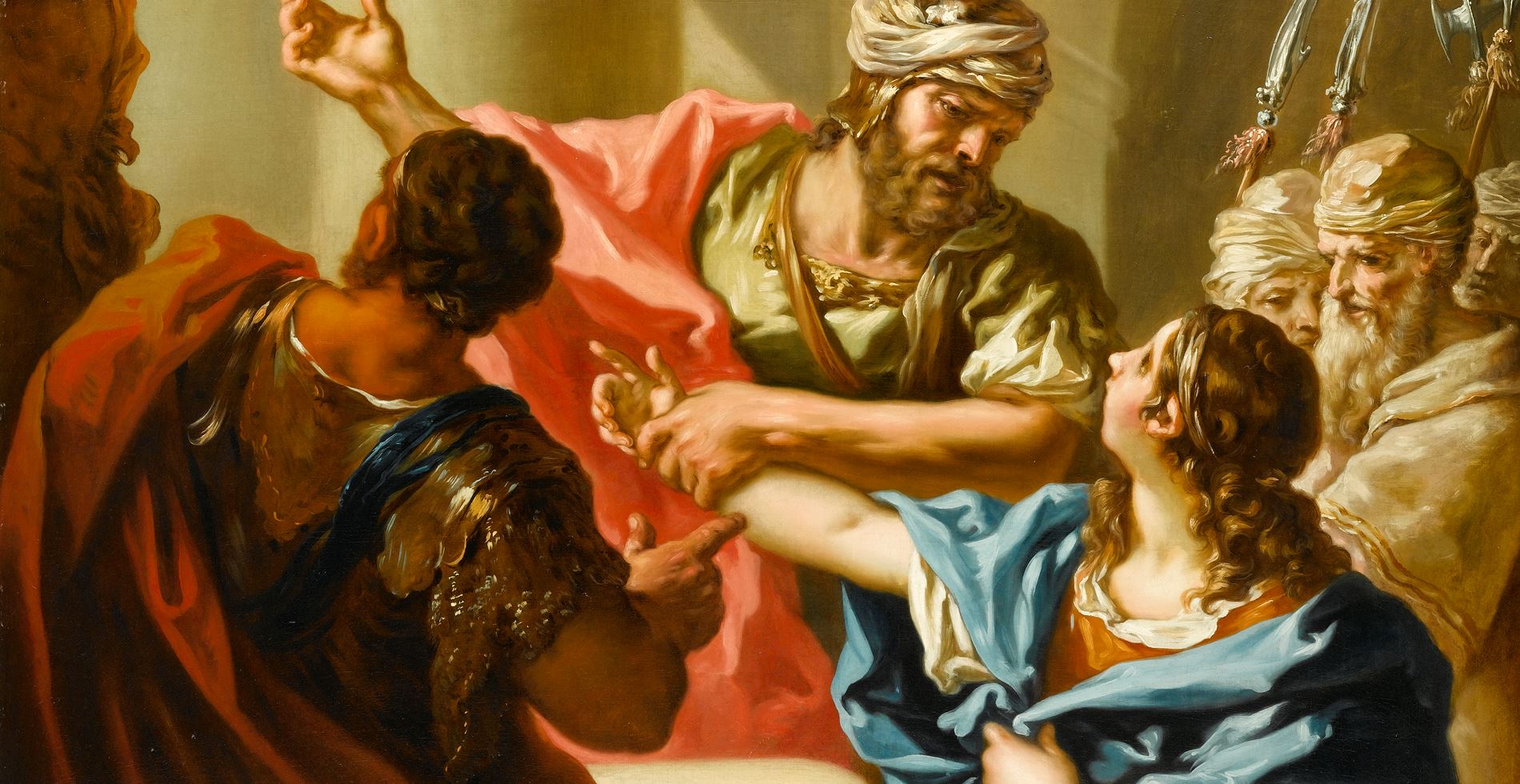
In this powerful work, Giovanni Antonio Pellegrini depicts one of the formative episodes in the life of Hannibal (147-183/182 BC), the famed Carthaginian general who is considered one of the great military leaders of antiquity. Hannibal’s father was Hamilcar Barca (c. 275-228 BC), commander of Carthage during their defeat to Rome in the First Punic War (264-241 BC). In the wake of this defeat, Hamilcar aimed to subjugate the tribes of the Iberian Peninsula. As Livy relates ‘Hannibal, then about nine years old, begged, with all the childish arts he could muster, to be allowed to accompany him; whereupon Hamilcar, who was preparing to offer sacrifice for a successful outcome, led the boy to the altar and made him solemnly swear, with his hand upon the sacred victim, that as soon as he was old enough he would be the enemy of the Roman people’.¹
This is the scene which Pellegrini has depicted, and he has opted to almost fill the composition with his figures, which focuses attention to the emotional relationship between father and son. Hannibal is depicted deliberately youthful and innocent, his face upturned to his father with an expression of naivety and awe. There is no hint of the great warrior that he will become. Hamilcar towers above his son, and looks down at him with a fierce expression, as if to try and convey to him the importance of the oath. Although his son is only a child, Hamilcar has a strong grip on his arm, and this rough treatment suggests that if Hannibal is ready to take this oath, then he is ready to be treated as an adult. Indeed this moment can be seen as the start of Hannibal’s journey from a child to the great general who surpassed the achievements of the powerful warrior depicted here.
There is another version of the present work hanging over the doors in the former Antechamber if the Residenz at Würzburg. This version, along with its pendant Polyxena Led to Sacrifice,² is larger, but otherwise is almost identical with the exception of absence of the third halberdier at the extreme right-hand side of the composition. However, the Würzburg version is coarser in its handling, and less finely detailed, as would be expected from a work designed to be hung high up. The Würzburg picture probably dates to 1737, and the present version is commonly thought by scholars to predate this, although the date of execution is disputed. Rodolfo Pallucchini believes Pellegrini painted the present work c. 1731,³ although Bernard Aikema and Professor Alessandro Bettagno believe this date should be slightly later, c. 1737.⁴
The emotional intensity of Young Hannibal Swears Enmity to Rome is heightened by Pellegrini’s theatrical composition. Emotions and gestures are expressed dramatically, which gives the work clarity of narrative. Similar techniques are in evidence in Achilles Discovered with the Daughters of Lycomedes. In that work the composition has been arranged so that the viewer’s gaze is immediately drawn and held by the figure of Achilles, holding a sword and disguised as a young woman. The realisation and shock on Achilles’ face, as he realises that he has been tricked into revealing his identity is the central aspect of the work. As with Young Hannibal Swears Enmity to Rome, it is the emotional responses of the protagonists that seems to chiefly concern Pellegrini, and in order to focus attention upon this he ensures that his figures dominate the canvas, and discards superfluous details and background which could distract the viewer.
Hannibal’s upturned profile in the present work is a common motif in Pellegrini’s work. It reoccurs in many of his paintings, for example in the figure of the fiancé in The Continence of Scipio. In fact this figure, with his long hair and youthful appearance, seems to derive from the same model as the young Hannibal. By using the technique of an upturned face, Pellegrini effectively conveys one figure’s subservience to the other. It also serves to underline the figure’s gaze and the pyramidal composition, and so places emphasis on the central figure in the narrative. Pellegrini’s ability to arrange a composition full of clarity is one of the outstanding features of his art.
A notable feature of Young Hannibal Swears Enmity to Rome is the rich and vivid colouring used by Pellegrini. The palette is dominated by shades of yellow and gold, as the picture is flooded in warm light, which is enlivened with the large areas of deep red and blue that make up Hannibal and Hamilcars’ cloaks. This dynamic use of colour is often seen in Pellegrini’s work, another example being The Clemency of Alexander before the Family of Darius. The red, yellow and blue of the central figures’ costume immediately draws the viewer’s attention and helps them emerge from the muted background. The theatricality of this colouring is bought to prominence even further by Pellegrini’s effective use of chiaroscuro. This skilful modelling of light is a feature in the present work but is even more in evidence in a painting such as Mucius Scaevola before Porsenna (Museo del Settecento Veneziano, Venice.)
Pellegrini, together with Sebastiano Ricci (1659-1734) and Jacopo Amigoni (c. 1685-1752), was one of the finest Venetian history painters of his day. Credited with seamlessly melding the Renaissance style promoted by Paulo Veronese (1528-1588) with the Baroque of Pietro da Cortona (1596-1669( and Luca Giordano (1634-1705), Pellegrini enjoyed great popularity amongst the European aristocracy. He travelled widely around Europe executing elegant commissions to decorate the palatial residences of the wealthy upper classes.
Having trained under P. Pagani (1661-1716) in Venice, Pellegrini was invited to England in 1708 by the British ambassador to Venice, Charles Montagu. Whilst there he decorated the stairwell of Montagu’s London home in Arlington Street, which has since been destroyed. The following year, Pellegrini, along with Marco Ricci (1676-1730) who had also been invited over to England by the ambassador, painted the set designs for Alessandro Scarlatti’s opera, Pirro e Demetrio and for Giovanni Bononcini’s Camilla. That same year he received a commission from Charles, the 3rd Earl of Carlisle to paint the cupola, staircases and entrance hall of Vanburgh’s magnificent Castle Howard in North Yorkshire which was largely destroyed by fire in 1941. Employing the fashionable genre of mythological and allegorical paintings, Pellegrini created a dramatic version of the Fall of Phaethon for the cupola and used the walls for allegorical settings. Following this success at Castle Howard, Pellegrini was also called upon to decorate another of Charles Montagu’s residences, Kimbolton Castle. He adorned the walls with The Triumph of a Roman Emperor and a rendition of Minerva on the ceiling. Minerva includes a portrait of the patron upheld by putti. Again, the light and radiant colours are indebted to Veronese; the scene of musicians playing a fanfare, painted in a triangular area, is brilliantly accomplished, both as an independent work and as part of the whole. Both of these frescoes represent the most important surviving British achievement with a spaciousness of design and a radiance of colour that anticipates Giambattista Tiepolo (1695-1770).
Other large-scale projects undertaken whilst in England include a series of mythological canvases originally intended for Burlington House, London which hang now in Narford Hall, Norfolk. Pellegrini worked with Sebastiano Ricci on this commission and together they produced Diana and her Nymphs Bathing.
Pellegrini was particularly successful in England and through his acquaintance with Sir Godfrey Kneller (1646-1723) he assisted in the foundation of Kneller’s Academy in London in 1711 and also became a director. Pellegrini even submitted designs for the dome of the new St. Paul’s Cathedral and his design is said to have been Sir Christopher Wren’s (1632-1723) preferred choice. In the end Pellegrini was pipped to the post by the English painter Sir John Thornhill (1675-1724) who received the commission instead. This anecdote in itself goes some way to demonstrate the great esteem in which Pellegrini was held. His rivals for the St. Paul’s commission included some of the greatest European artists of the day: Juan-Baptiste Catenaro, Pierre Berchet and Louis Laguerre (1663-1721) were among his competitors. According to the writer and antiquarian George Vertue, Sebastiano Ricci on finding out that the commission had been awarded to Thornhill, ‘left England once and for all when he found it was resolved that Mr. Thornhill shou’d paint the Cupolo of St. Paul’s’.
Pellegrini left England in 1713. Subsequently he was employed by Johann Wilhelm, Elector of the Palatinate in Düsseldorf for whom he painted The Fall of the Giants and The Fall of Phaethon to adorn the stairwell of the Elector’s Schloss Bensberg. He also completed a series of allegorical canvases to celebrate the Elector’s rule. These are commonly regarded as the apex of his achievement as a history painter. Pellegrini worked all over Europe, in Antwerp, The Hague, Würzburg, Dresden, Mannheim and Vienna. Following this extensive travelling, Pellegrini finally settled in Venice for the remaining years of his life.
In 1735 he was paid for the delivery of an altarpiece, St. Catherine, for the Santo in Padua, which is now in the library of the Santo. Pellegrini had an important collection of Dutch art, which, after his death, was acquired by the English consul Vivian Smith. His work was widely influential and played an important role in the formative years of Tiepolo and Giovanni Antonio Guardi (1699-1760).
¹ Livy, The War with Hannibal: The History of Rome from its Foundations, Book XXI, trans. Aubrey de Sélincourt.
² Knox, G., Antonio Pellegrini (Oxford, 1995), p. 265, cat. no. P.509, illustrated plate 145.
³ Pallucchini, R., ‘Novita 'ed appunti per Giovanni Antonio Pellegrini’ in Pantheon, vol. XVIII, 1960, pp.247-248.
⁴ The Matthiesen Gallery, The Settecento 1700-1800, 1987, no. 10.
Ruggero Sonino, Venice;
Anonymous sale, London, Christie’s April 24th, 1981, lot 98;
The Matthiesen Gallery, London.
Rodolfo Pallucchini, ‘Novita 'ed appunti per Giovanni Antonio Pellegrini’ in Pantheon, vol. XVIII, 1960, pp.247-248, reproduced;
George Knox, Antonio Pellegrini (Oxford, 1995), p. 239, cat. no. P.169.
London, The Matthiesen Gallery, The Settecento 1700-1800, 1987, no. 10, pl. 5.



‘When I come to age, I shall pursue the Romans with fire and sword and enact again the doom of Troy. The gods shall not stop my career, nor the treaty that bars the sword, neither the lofty Alps nor the Tarpeian rock. I swear to this purpose by the divinity of our native god of war, and by the shade of Elissa.’
- Silius Italicus, Punica, Book I, 114-119
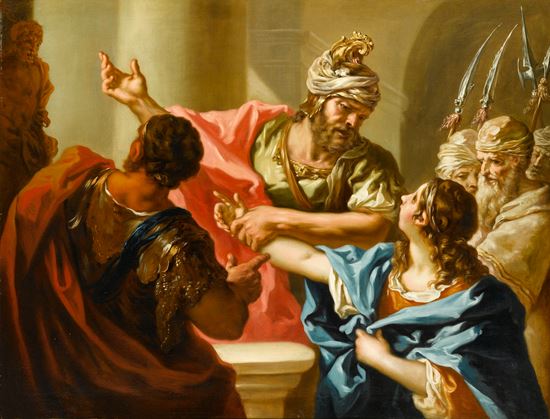
In this powerful work, Giovanni Antonio Pellegrini depicts one of the formative episodes in the life of Hannibal (147-183/182 BC), the famed Carthaginian general who is considered one of the great military leaders of antiquity. Hannibal’s father was Hamilcar Barca (c. 275-228 BC), commander of Carthage during their defeat to Rome in the First Punic War (264-241 BC). In the wake of this defeat, Hamilcar aimed to subjugate the tribes of the Iberian Peninsula. As Livy relates ‘Hannibal, then about nine years old, begged, with all the childish arts he could muster, to be allowed to accompany him; whereupon Hamilcar, who was preparing to offer sacrifice for a successful outcome, led the boy to the altar and made him solemnly swear, with his hand upon the sacred victim, that as soon as he was old enough he would be the enemy of the Roman people’.¹
This is the scene which Pellegrini has depicted, and he has opted to almost fill the composition with his figures, which focuses attention to the emotional relationship between father and son. Hannibal is depicted deliberately youthful and innocent, his face upturned to his father with an expression of naivety and awe. There is no hint of the great warrior that he will become. Hamilcar towers above his son, and looks down at him with a fierce expression, as if to try and convey to him the importance of the oath. Although his son is only a child, Hamilcar has a strong grip on his arm, and this rough treatment suggests that if Hannibal is ready to take this oath, then he is ready to be treated as an adult. Indeed this moment can be seen as the start of Hannibal’s journey from a child to the great general who surpassed the achievements of the powerful warrior depicted here.
There is another version of the present work hanging over the doors in the former Antechamber if the Residenz at Würzburg. This version, along with its pendant Polyxena Led to Sacrifice,² is larger, but otherwise is almost identical with the exception of absence of the third halberdier at the extreme right-hand side of the composition. However, the Würzburg version is coarser in its handling, and less finely detailed, as would be expected from a work designed to be hung high up. The Würzburg picture probably dates to 1737, and the present version is commonly thought by scholars to predate this, although the date of execution is disputed. Rodolfo Pallucchini believes Pellegrini painted the present work c. 1731,³ although Bernard Aikema and Professor Alessandro Bettagno believe this date should be slightly later, c. 1737.⁴
The emotional intensity of Young Hannibal Swears Enmity to Rome is heightened by Pellegrini’s theatrical composition. Emotions and gestures are expressed dramatically, which gives the work clarity of narrative. Similar techniques are in evidence in Achilles Discovered with the Daughters of Lycomedes. In that work the composition has been arranged so that the viewer’s gaze is immediately drawn and held by the figure of Achilles, holding a sword and disguised as a young woman. The realisation and shock on Achilles’ face, as he realises that he has been tricked into revealing his identity is the central aspect of the work. As with Young Hannibal Swears Enmity to Rome, it is the emotional responses of the protagonists that seems to chiefly concern Pellegrini, and in order to focus attention upon this he ensures that his figures dominate the canvas, and discards superfluous details and background which could distract the viewer.
Hannibal’s upturned profile in the present work is a common motif in Pellegrini’s work. It reoccurs in many of his paintings, for example in the figure of the fiancé in The Continence of Scipio. In fact this figure, with his long hair and youthful appearance, seems to derive from the same model as the young Hannibal. By using the technique of an upturned face, Pellegrini effectively conveys one figure’s subservience to the other. It also serves to underline the figure’s gaze and the pyramidal composition, and so places emphasis on the central figure in the narrative. Pellegrini’s ability to arrange a composition full of clarity is one of the outstanding features of his art.
A notable feature of Young Hannibal Swears Enmity to Rome is the rich and vivid colouring used by Pellegrini. The palette is dominated by shades of yellow and gold, as the picture is flooded in warm light, which is enlivened with the large areas of deep red and blue that make up Hannibal and Hamilcars’ cloaks. This dynamic use of colour is often seen in Pellegrini’s work, another example being The Clemency of Alexander before the Family of Darius. The red, yellow and blue of the central figures’ costume immediately draws the viewer’s attention and helps them emerge from the muted background. The theatricality of this colouring is bought to prominence even further by Pellegrini’s effective use of chiaroscuro. This skilful modelling of light is a feature in the present work but is even more in evidence in a painting such as Mucius Scaevola before Porsenna (Museo del Settecento Veneziano, Venice.)
Pellegrini, together with Sebastiano Ricci (1659-1734) and Jacopo Amigoni (c. 1685-1752), was one of the finest Venetian history painters of his day. Credited with seamlessly melding the Renaissance style promoted by Paulo Veronese (1528-1588) with the Baroque of Pietro da Cortona (1596-1669( and Luca Giordano (1634-1705), Pellegrini enjoyed great popularity amongst the European aristocracy. He travelled widely around Europe executing elegant commissions to decorate the palatial residences of the wealthy upper classes.
Having trained under P. Pagani (1661-1716) in Venice, Pellegrini was invited to England in 1708 by the British ambassador to Venice, Charles Montagu. Whilst there he decorated the stairwell of Montagu’s London home in Arlington Street, which has since been destroyed. The following year, Pellegrini, along with Marco Ricci (1676-1730) who had also been invited over to England by the ambassador, painted the set designs for Alessandro Scarlatti’s opera, Pirro e Demetrio and for Giovanni Bononcini’s Camilla. That same year he received a commission from Charles, the 3rd Earl of Carlisle to paint the cupola, staircases and entrance hall of Vanburgh’s magnificent Castle Howard in North Yorkshire which was largely destroyed by fire in 1941. Employing the fashionable genre of mythological and allegorical paintings, Pellegrini created a dramatic version of the Fall of Phaethon for the cupola and used the walls for allegorical settings. Following this success at Castle Howard, Pellegrini was also called upon to decorate another of Charles Montagu’s residences, Kimbolton Castle. He adorned the walls with The Triumph of a Roman Emperor and a rendition of Minerva on the ceiling. Minerva includes a portrait of the patron upheld by putti. Again, the light and radiant colours are indebted to Veronese; the scene of musicians playing a fanfare, painted in a triangular area, is brilliantly accomplished, both as an independent work and as part of the whole. Both of these frescoes represent the most important surviving British achievement with a spaciousness of design and a radiance of colour that anticipates Giambattista Tiepolo (1695-1770).
Other large-scale projects undertaken whilst in England include a series of mythological canvases originally intended for Burlington House, London which hang now in Narford Hall, Norfolk. Pellegrini worked with Sebastiano Ricci on this commission and together they produced Diana and her Nymphs Bathing.
Pellegrini was particularly successful in England and through his acquaintance with Sir Godfrey Kneller (1646-1723) he assisted in the foundation of Kneller’s Academy in London in 1711 and also became a director. Pellegrini even submitted designs for the dome of the new St. Paul’s Cathedral and his design is said to have been Sir Christopher Wren’s (1632-1723) preferred choice. In the end Pellegrini was pipped to the post by the English painter Sir John Thornhill (1675-1724) who received the commission instead. This anecdote in itself goes some way to demonstrate the great esteem in which Pellegrini was held. His rivals for the St. Paul’s commission included some of the greatest European artists of the day: Juan-Baptiste Catenaro, Pierre Berchet and Louis Laguerre (1663-1721) were among his competitors. According to the writer and antiquarian George Vertue, Sebastiano Ricci on finding out that the commission had been awarded to Thornhill, ‘left England once and for all when he found it was resolved that Mr. Thornhill shou’d paint the Cupolo of St. Paul’s’.
Pellegrini left England in 1713. Subsequently he was employed by Johann Wilhelm, Elector of the Palatinate in Düsseldorf for whom he painted The Fall of the Giants and The Fall of Phaethon to adorn the stairwell of the Elector’s Schloss Bensberg. He also completed a series of allegorical canvases to celebrate the Elector’s rule. These are commonly regarded as the apex of his achievement as a history painter. Pellegrini worked all over Europe, in Antwerp, The Hague, Würzburg, Dresden, Mannheim and Vienna. Following this extensive travelling, Pellegrini finally settled in Venice for the remaining years of his life.
In 1735 he was paid for the delivery of an altarpiece, St. Catherine, for the Santo in Padua, which is now in the library of the Santo. Pellegrini had an important collection of Dutch art, which, after his death, was acquired by the English consul Vivian Smith. His work was widely influential and played an important role in the formative years of Tiepolo and Giovanni Antonio Guardi (1699-1760).
¹ Livy, The War with Hannibal: The History of Rome from its Foundations, Book XXI, trans. Aubrey de Sélincourt.
² Knox, G., Antonio Pellegrini (Oxford, 1995), p. 265, cat. no. P.509, illustrated plate 145.
³ Pallucchini, R., ‘Novita 'ed appunti per Giovanni Antonio Pellegrini’ in Pantheon, vol. XVIII, 1960, pp.247-248.
⁴ The Matthiesen Gallery, The Settecento 1700-1800, 1987, no. 10.
Ruggero Sonino, Venice;
Anonymous sale, London, Christie’s April 24th, 1981, lot 98;
The Matthiesen Gallery, London.
Rodolfo Pallucchini, ‘Novita 'ed appunti per Giovanni Antonio Pellegrini’ in Pantheon, vol. XVIII, 1960, pp.247-248, reproduced;
George Knox, Antonio Pellegrini (Oxford, 1995), p. 239, cat. no. P.169.
London, The Matthiesen Gallery, The Settecento 1700-1800, 1987, no. 10, pl. 5.
You may also like
(Venice 1675 - Venice 1741)
(Venice 1675 - Venice 1741)
(Venice 1675 - Venice 1741)