Giovanni Battista Tiepolo
(Venice 1697 - Madrid 1770)
Death of Seneca
 contact
iovanni Battista Tiepolo
(Venice 1697 - Madrid 1770)
Death of Seneca
pen and brown ink and grey wash over black chalk
42.8 x 28.2 cm (16⅞ x 11⅛ in)
 +44 20 7313 8040
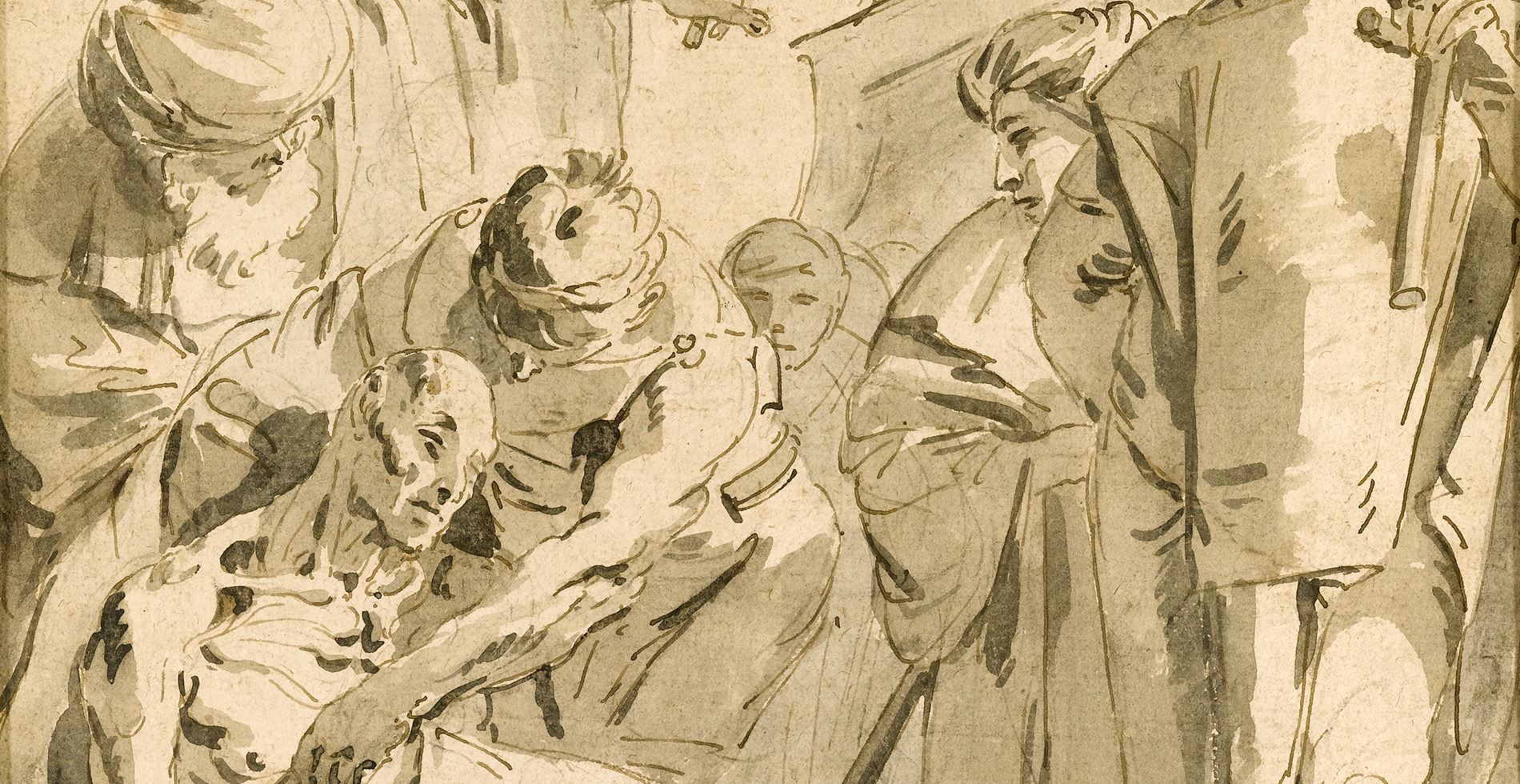
Charged with conspiracy by Emperor Nero, Seneca chose to commit suicide rather than face the humiliation of execution. This narrative of the Roman Empire was a popular subject in Italy in the 1700s and reflected the revival of interest in Stoicism. Stoic philosophers like Seneca, argued for the control of the emotions, and his suicide embodied this repression of feeling. Having slit his own wrists and taken poison, Seneca slips into unconsciousness and is helped into a warm bath of water by some compassionate friends to hasten his death. The work demonstrates why, as an expression of artistic imagination, it has been said that Giovanni Battista Tiepolo’s ‘graphic work can be compared only with that of Rembrandt.’¹
The subject of Seneca’s death was one which Tiepolo was to return to on several occasions. In addition to the themes of dignity, bravery and reason, Seneca is described by Tacitus as aged and thin, and Tiepolo clearly relishes the visual impact of this skeletal figure close to death. The present drawing is an early example of Tiepolo’s draughtsmanship, dating to the 1720s, and there is an oil painting of the same subject dating from that decade (Private Collection). Although the two works are compositionally very different, the focus is very much on the arresting figure of Seneca. In both works he is almost helpless, as death overcomes him and he has to be supported by a companion. In each case, Tiepolo opts to depict the philosopher with a bare torso, which allows the viewer to contemplate his frailty. His gaunt body, which exposes his bones and sinews, is a dramatic sight and it emphasises the contrast between Seneca’s physical weakness and his considerable mental strength.
Clearly Tiepolo was fascinated by the pictorial potential of the narrative, in which he could depict someone so close to death. Another slightly later drawing in Chicago shows Seneca starting to slide from his chair, his arms akimbo. It is a slightly more dramatic and theatrical pose, perhaps designed to convey with more clarity the agony of death. However, Tiepolo defines less clearly Seneca’s physical weakness, and with its heightened sense of drama, the Chicago work does not capture the same spirit of stoicism which Seneca represents.
As Adriano Mariuz has said of Tiepolo’s graphic work, ‘The subjects frequently recur, but the interpretation differs every time’.² In his depiction of Seneca, Tiepolo appears to have taken inspiration from Guido Reni’s (1575-1642) sculpture of that figure. A bronze bust, Reni’s only known sculpture, was widely reproduced in plaster and according to the seventeenth-century art historian Carlo Cesare Malvasia (1616-1693), was used in many art academies.³ Despite Tiepolo’s inventiveness and freedom of technique, he did follow traditional studio practice and make drawings after sculptures.
As discussed, the present work dates from the 1720s, when Tiepolo’s draughstmanship was still under the influence of Luca Giordano (1604 - 1705). These early drawings, which have the dashing fluid manner of Giordano, are relatively rare, despite the fact that Tiepolo was a prolific draughtsman. Comparable examples include The Decapitation of a Bishop, (Civici Musei di Storia e Arte, Trieste) and A Sacrifice. These three drawings feature a rapidity of execution which powerfully heightens the drama of death. Tiepolo uses the grave expressions of the onlookers to accentuate the emotion of his scenes. The expressive power of these drawings is all the more remarkable given the narrow compositions he restricts himself to.
Also known as ‘Giambattista’, Tiepolo was one of the most brilliant and sought after Italian painters of the eighteenth century, and represents the ultimate achievement of the Venetian tradition of decorative painting in the Grand Manner. He also painted numerous large-scale oil paintings, a wide repertory of oil sketches, and was an accomplished draughtsman as well as a successful and original etcher. He had been trained in Venice and brought up to admire the achievements of the great Venetian Renaissance masters, above all Tintoretto and Veronese. Death of Seneca exemplifies how Tiepolo, through rhetorical gesture and facial expression, created a theatrical sense of composition and design, and an imaginative appreciation of the physical context in which his work would be seen. Tiepolo became extremely successful at projecting narrative and telling a story with dramatic effect, whether of religious or secular subject matter.
Over his long career he worked throughout Europe, becoming one of the most sought after artists of the period. A contemporary describes Tiepolo as ‘the most famous Venetian painter, the most renowned...well-known in Europe, and the most honoured in his own country’.⁴ Although he is best remembered for his grandiose oil paintings it is in his graphic work that we see ‘the freest, most complete expression of his genius’.⁵
When the present drawing was sold in 1983, the attribution was confirmed by Professor George Knox, after having seen it in the original.
¹ Mariuz, A., ‘Giambattista Tiepolo’ in The Glory of Venice: Art in the Eighteenth Century, exh. cat. (Royal Academy of Arts, London, 1994), p.182
² Ibid.
³ Kurz, O., ‘A Sculpture by Guido Reni’, in The Burlington Magazine, vol. LXXXI, no. 474, September 1942, pp. 222-226.
⁴ Pietro Gradenigo, Annali, quoted in Livan, L., ed. Notizie tratte dai Notatori e dai Annali del N. H. Pietro Gradenigo (Venice, 1942) pp. 191-2.
⁵ Mariuz, p.182.
Anonymous sale, London, Christie’s, 5th July 1983, lot 128;
acquired by Jeffrey E. Horvitz in 1984.



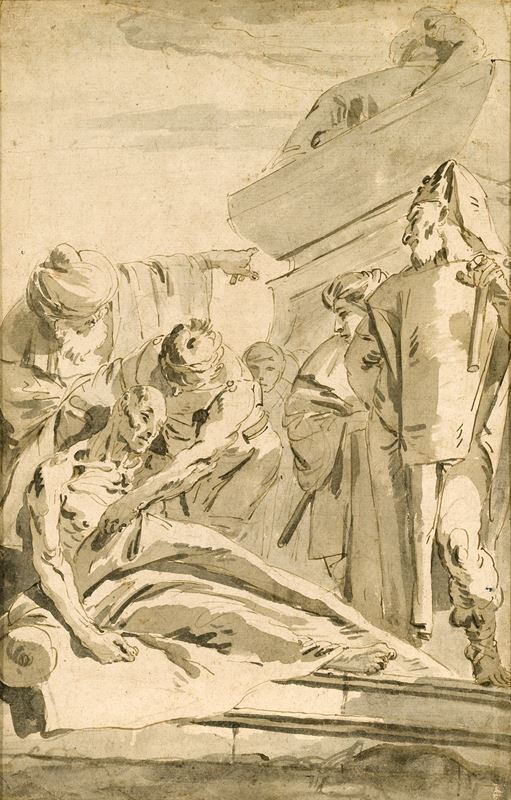
Charged with conspiracy by Emperor Nero, Seneca chose to commit suicide rather than face the humiliation of execution. This narrative of the Roman Empire was a popular subject in Italy in the 1700s and reflected the revival of interest in Stoicism. Stoic philosophers like Seneca, argued for the control of the emotions, and his suicide embodied this repression of feeling. Having slit his own wrists and taken poison, Seneca slips into unconsciousness and is helped into a warm bath of water by some compassionate friends to hasten his death. The work demonstrates why, as an expression of artistic imagination, it has been said that Giovanni Battista Tiepolo’s ‘graphic work can be compared only with that of Rembrandt.’¹
The subject of Seneca’s death was one which Tiepolo was to return to on several occasions. In addition to the themes of dignity, bravery and reason, Seneca is described by Tacitus as aged and thin, and Tiepolo clearly relishes the visual impact of this skeletal figure close to death. The present drawing is an early example of Tiepolo’s draughtsmanship, dating to the 1720s, and there is an oil painting of the same subject dating from that decade (Private Collection). Although the two works are compositionally very different, the focus is very much on the arresting figure of Seneca. In both works he is almost helpless, as death overcomes him and he has to be supported by a companion. In each case, Tiepolo opts to depict the philosopher with a bare torso, which allows the viewer to contemplate his frailty. His gaunt body, which exposes his bones and sinews, is a dramatic sight and it emphasises the contrast between Seneca’s physical weakness and his considerable mental strength.
Clearly Tiepolo was fascinated by the pictorial potential of the narrative, in which he could depict someone so close to death. Another slightly later drawing in Chicago shows Seneca starting to slide from his chair, his arms akimbo. It is a slightly more dramatic and theatrical pose, perhaps designed to convey with more clarity the agony of death. However, Tiepolo defines less clearly Seneca’s physical weakness, and with its heightened sense of drama, the Chicago work does not capture the same spirit of stoicism which Seneca represents.
As Adriano Mariuz has said of Tiepolo’s graphic work, ‘The subjects frequently recur, but the interpretation differs every time’.² In his depiction of Seneca, Tiepolo appears to have taken inspiration from Guido Reni’s (1575-1642) sculpture of that figure. A bronze bust, Reni’s only known sculpture, was widely reproduced in plaster and according to the seventeenth-century art historian Carlo Cesare Malvasia (1616-1693), was used in many art academies.³ Despite Tiepolo’s inventiveness and freedom of technique, he did follow traditional studio practice and make drawings after sculptures.
As discussed, the present work dates from the 1720s, when Tiepolo’s draughstmanship was still under the influence of Luca Giordano (1604 - 1705). These early drawings, which have the dashing fluid manner of Giordano, are relatively rare, despite the fact that Tiepolo was a prolific draughtsman. Comparable examples include The Decapitation of a Bishop, (Civici Musei di Storia e Arte, Trieste) and A Sacrifice. These three drawings feature a rapidity of execution which powerfully heightens the drama of death. Tiepolo uses the grave expressions of the onlookers to accentuate the emotion of his scenes. The expressive power of these drawings is all the more remarkable given the narrow compositions he restricts himself to.
Also known as ‘Giambattista’, Tiepolo was one of the most brilliant and sought after Italian painters of the eighteenth century, and represents the ultimate achievement of the Venetian tradition of decorative painting in the Grand Manner. He also painted numerous large-scale oil paintings, a wide repertory of oil sketches, and was an accomplished draughtsman as well as a successful and original etcher. He had been trained in Venice and brought up to admire the achievements of the great Venetian Renaissance masters, above all Tintoretto and Veronese. Death of Seneca exemplifies how Tiepolo, through rhetorical gesture and facial expression, created a theatrical sense of composition and design, and an imaginative appreciation of the physical context in which his work would be seen. Tiepolo became extremely successful at projecting narrative and telling a story with dramatic effect, whether of religious or secular subject matter.
Over his long career he worked throughout Europe, becoming one of the most sought after artists of the period. A contemporary describes Tiepolo as ‘the most famous Venetian painter, the most renowned...well-known in Europe, and the most honoured in his own country’.⁴ Although he is best remembered for his grandiose oil paintings it is in his graphic work that we see ‘the freest, most complete expression of his genius’.⁵
When the present drawing was sold in 1983, the attribution was confirmed by Professor George Knox, after having seen it in the original.
¹ Mariuz, A., ‘Giambattista Tiepolo’ in The Glory of Venice: Art in the Eighteenth Century, exh. cat. (Royal Academy of Arts, London, 1994), p.182
² Ibid.
³ Kurz, O., ‘A Sculpture by Guido Reni’, in The Burlington Magazine, vol. LXXXI, no. 474, September 1942, pp. 222-226.
⁴ Pietro Gradenigo, Annali, quoted in Livan, L., ed. Notizie tratte dai Notatori e dai Annali del N. H. Pietro Gradenigo (Venice, 1942) pp. 191-2.
⁵ Mariuz, p.182.
Anonymous sale, London, Christie’s, 5th July 1983, lot 128;
acquired by Jeffrey E. Horvitz in 1984.
You may also like
(Venice 1697 - Madrid 1770)
(Venice 1697 - Madrid 1770)
(Venice 1697 - Madrid 1770)