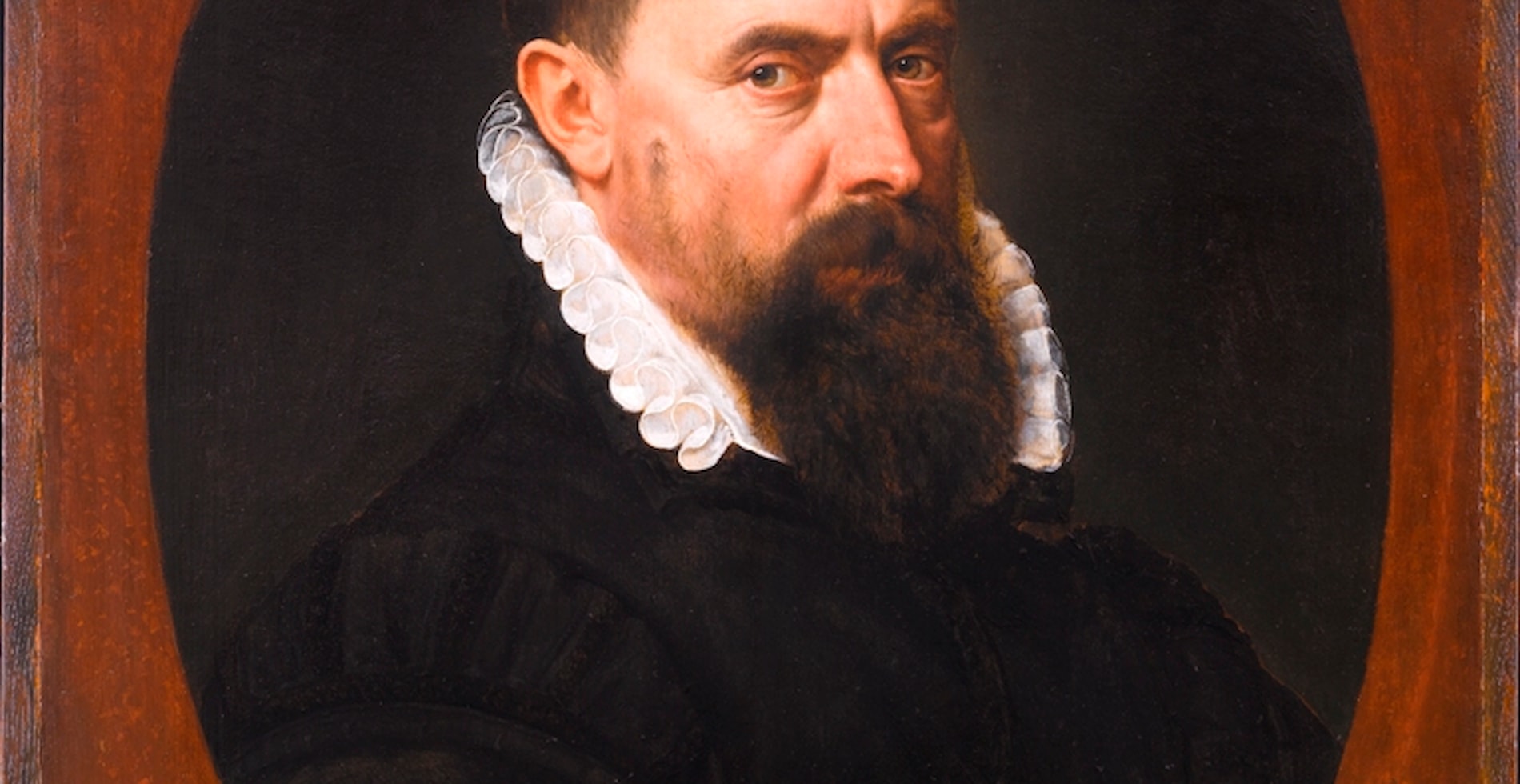
Adriaen Thomasz. Key
(Antwerp c.1544 - Antwerp after 1589)
Portrait of a Bearded Gentleman, Bust-Length, in a Black Doublet with a White Lace Ruff
 contact
driaen Thomasz. Key
(Antwerp c.1544 - Antwerp after 1589)
Portrait of a Bearded Gentleman, Bust-Length, in a Black Doublet with a White Lace Ruff
signed with monogram 'ATK' (in ligature) and inscribed ‘AETA: 48’ (upper right) and dated ‘1574’ (upper left)
oil on panel, painted in a feigned oval
75.6 x 60.3 cm (29¾ x 23¾ in)
 contact
 +44 20 7313 8040
This remarkable portrait of a forty-eight year old man, painted in 1574, is a fine example of the portraiture of Adriaen Thomasz. Key during the period when ‘he was at the height of his ability’ as an artist.¹ The sitter wears a black doublet with very little ornamentation, against which his starched white ruff stands out. Key has here imbued his subject with a palpable humanity, giving him a stronger presence than his otherwise plain features and clothing would suggest. The keen attention paid to the details of the man’s appearance, from the wayward strands of his beard climbing up his cheek to the lines on his skin and the shadows around his eyes, seem to be designed to kindle the viewer’s empathy for the sitter. Although the portrait has no Italian influence, the work recalls Leon Battista Alberti’s Renaissance ideal ‘that the art of painting harbours a divine force making those who are absent present...and raising the dead to life’.²
It is only after recent cleaning that the present work can be securely attributed to Key. Before the Second World War, the painting had traditionally been thought to be the work of Antonis Mor (c. 1517-1577), who worked in Antwerp and who was clearly a major influence on his work. Since the Second World War, whilst the painting was in the custody of the Dutch Government, an attribution to Frans Pourbus the Elder (1545-1581) had been assigned and generally accepted. Pourbus is an artist whose work is often confused with that of Key, and it should be born in mind that throughout the twentieth century Key’s monogram was obscured a layer of old and extremely dirty varnish. Despite this, the leading scholar on Key’s work, Prof. Dr. Koenraad Jonckheere, recognised the present painting on stylistic grounds as the work of Key, and published it in his 2007 monograph as an unsigned work.³ Now, after careful cleaning, Key’s monogram has been revealed and any uncertainty over the attribution has been dispelled.
Portrait of a Bearded Gentleman is an excellent example of Key’s bust-length portraiture, comparable to some his best work, such as Bust Portrait of Gillis Beys (1571, Plantin-Moretus Museum, Antwerp ). In both paintings the sitters are dressed in very dark simple clothing, which merge with the black backgrounds. Against this darkness, the visages of both figures appear illuminated and heightened, so that the viewer’s focus is on Key’s exceptional rendering of his subject’s facial features. Both works demonstrate Key’s meticulous attention to detail, with each wrinkle and blemish carefully depicted. Both sitters have beards, a feature Key excelled in depicting because, as Jonckheere has pointed out, ‘Unlike Willem Key or Frans Pourbus the Elder, for example, whose portraits often closely resemble those of Adriaen Thomasz., the latter always painted a beard into a full mass hair by hair’.⁴ It is his patience and devotion to detail, so evident in these works. that make Key such an engrossing portraitist.
It is notable that the ruthless objectivity of Key’s portrayal of our anonymous gentleman was applied by the artist in all his commissions, including his most prestigious, such as his Portrait of William I (1544-84), Prince of Orange. In this work, of which there are three versions, Key does not attempt to idealise the prince but provides a realistic image of the slightly worn face of a middle aged man. William is wearing an embroidered gown and a calotte, or small cap, thus he is portrayed as a civilian, with no reference to his great military past. Although William is well groomed, as one would expect from one of his noble status, Key has not shied away from portraying the Prince’s thinning hair, furrowed brow, or the bags under his eyes. Key has composed Portrait of William I and Portrait of a Bearded Gentleman in a comparable manner, and both works they turn their heads slightly and look out directly at the viewer. Although there is no great animation in either portrait their gazes are imbued with a restrained confidence. Such is Key’s skill that, although these gazes are almost expressionless, due to the depiction of the eyes, there is psychological depth to each figure.
Although the present work, like many of Key’s portraits, is relatively stark and free of iconography, so that the focus is on the sitter’s appearance in his larger, three-quarter length works, Key occasionally included extra, symbolic elements, to refer to a particular aspect of his subject’s character. One such example is the Pushkin Museum’s Portrait of a Man, (1573, Pushkin Museum, Moscow) painted just a year before the present work. As is typical of Key, ‘objective and reserved, he explored every wrinkle and crack in the face and hands and sculpted anatomical relief, as it were, with light and colour’.⁵ Much of the work is reminiscent of Portrait of a Bearded Gentleman, and yet on the table beside him ‘money, a ledger, pen, compass, nutcracker and salt tub leave little room for doubt that the man in question was an international dealer in spices’.⁶ Perhaps Key’s use of symbolism is most notable in the Prado’s masterpiece of 1583 Family Portrait, which contains the vanitas symbols of a skull and an hourglass. However, in when one compares these works which have elements of iconography, to the present work, they lack some of immediacy of Portrait of a Bearded Gentleman. Such is the vitality which Key subtly imbues within his subjects, that the extra details feel almost distracting, and deride from the visual power of the portrait. Jonckheere has suggested that in the case of Family Portrait, Key has deliberately dulled the eyes of the father, one of a number of reasons he cites to suggest that the father may have actually died, and that this is a memorial portrait.⁷ This theory has yet to be proved, but in the context of the tremendous psychological depth which Key’s subjects generally have, the Prado’s father is conspicuous.
After having his legacy overlooked for many years, the work of Key is undergoing a rapid critical reassessment, and he can now be considered one of the most significant portraitists of his generation. He was trained by Willem Key (c. 1515-1568), and was part of his workshop for many years. Traditionally it was thought that Adriaen was a relation of his master but it is now known that his family name was Thomasz. Adriaen only adopted the name Key after he took over his masters workshop in 1568, because of the advantages of aligning his work with a long-established and successful painter. In effect ‘He thus used the name ‘Key’ to brand his art’.⁸
Although he art was firmly rooted in the tradition of Willem, Adriaen developed his own style, arguably surpassing the work of his master. Although he is justifiably considered one of the great Antwerp portraitists, a genre which makes up ninety percent of his preserved oeuvre, he also painted numerous religious scenes in which he developed pre-existing ideas of Willem, and Michiel Coxcie (1499-1592).⁹ However, after Calvinists took over the administration of Antwerp in 1579, production of altarpieces ceased, and the demand for mythological or devotional work must have been minimal.
Although there is little biographical information on Key, it is clear that he was one of most talented and successful painters working in Antwerp. The present work is evidence if a talent that has too long been neglected by art history, and is rapidly finding recognition and appreciation.
Portrait of a Bearded Gentleman, Bust-Length, in a Black Doublet with a White Lace Ruff, in a Painted Oval has a notable and turbulent provenance. As yet, the earliest definite recording of the work is at the 1919 auction in Brussels, where it was purchased by Jules Porgès (1839-1921). Porgès was a wealthy Parisian businessman, who was a pioneering figure in the gold and diamond mining industries in South Africa. He retired from business in 1890, and devoted his remaining thirty-one years to building his art collection, which he housed in his Parisian home on the Avenue Montaigne. In addition to the present work, the collection included major paintings by Frans Hals (1585-1666), Joos van Cleve (c. 1485-c. 1540) and Jean Baptiste Greuze (1725-1805).
The present work later came into the collection of Jacques Goudstikker (1897-1940), one of the most notable art dealers of the twentieth century. Between the wars he built a flourishing career as a dealer, based on rigorous scholarship, and he staged major exhibitions throughout Europe and America. However, in 1940 when escaping Nazi persecution, he fell down an open hatch on the SS Bodegraven and died. On his person was his famous black notebook, in which he meticulously recorded his collection. The collection ended up in the hands of the Nazis, and after the war was given to the Dutch Government. It is only in 2006 that the paintings were finally returned to Goudstikker’s heirs, a task for which the black notebook proved invaluable.
¹ Jonckheere, K., Adriaen Thomasz. Key (c.1545-c.1589) Portrait of a Calvanist Painter, (Brepols, Turnhout, Belguim, 2007), p. 40.
² Alberti, L. B., On Painting, ed. John R. Spencer (New Haven, 1977), p. 63.
³ Jonckheere, p.116, no. 91.
⁴ Ibid., p.50.
⁵ Ibid., p. 77.
⁶ Ibid. p. 78.
⁷ Ibid. p.84.
⁸ Jonckheere, K., ‘Supply and Demand: Some Notes on the Economy of Seventeeth-Century Connoisseurship’, in Art Market and Connoisseurship: A Closer Look at Paintings by Rembrandt, Rubens and their Contemporaries, ed. Tummers, A. & Jonckheere, K. (Amsterdam University Press, Amsterdam, 2008), p. 72.
⁹ See inventory
Anonymous sale, J. Fiévez, Brussels, 3-4 July 1919 [=1st day], ‘Catalogue d'une collection importante de tableaux anciens & modernes dessins provenant de la Galerie du vicomte Jacques de la L. et autres provenances’, lot 121, illustrated, as Antonis Mor;
where acquired by Jules Porgès (1839-1921), Paris;
with Jacques Goudstikker, Amsterdam, by 1925 (where recorded by Max Friedländer), no. 1446, as Antonis Mor;
looted by the Nazi authorities, July 1940;
recovered by the Allies, 1945;
Institute for Cultural Heritage, Netherlands 1946-2006, inv no. NK 1906, as Frans Pourbus the Elder;
restituted in February 2006 to the heir of Jacques Goudstikker;
their sale, Christie’s, London, 5th July 2007, lot 24, as Frans Pourbus the Elder.
Christopher Wright, Paintings in Dutch Museums. An Index of Oil Paintings in Public Collections in The Netherlands by Artists born before 1870, (Sotheby Parke Bernet, London, 1980), p. 373, as attributed to Frans Pourbus I;
Old Master Paintings: An Illustrated Summary Catalogue, Rijksdienst Beeldende Kunst (The Netherlandish Office for the Fine Arts), The Hague, 1992, p. 243, no. 2106, illustrated, as Frans Pourbus (1);
Koenraad Jonckheere, Adriaen Thomasz. Key (c.1545-c. 1589) Portrait of a Calvanist Painter, (Brepols, Turnhout, Belguim, 2007) cat. no. A91, p. 116, illus. p. 298. as one of the 124 known works fully attributed to Adriaen Thomasz. Key.
Utrecht, Centraal Museum, Kersttentoonstelling van Werken van Eenige Oude Schilderigen uit de Collectie Goudstikker, 1925-1926, no. 17.


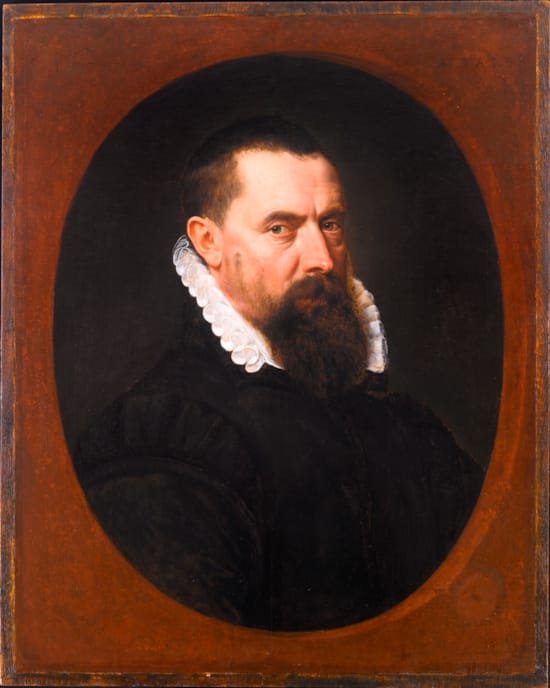
This remarkable portrait of a forty-eight year old man, painted in 1574, is a fine example of the portraiture of Adriaen Thomasz. Key during the period when ‘he was at the height of his ability’ as an artist.¹ The sitter wears a black doublet with very little ornamentation, against which his starched white ruff stands out. Key has here imbued his subject with a palpable humanity, giving him a stronger presence than his otherwise plain features and clothing would suggest. The keen attention paid to the details of the man’s appearance, from the wayward strands of his beard climbing up his cheek to the lines on his skin and the shadows around his eyes, seem to be designed to kindle the viewer’s empathy for the sitter. Although the portrait has no Italian influence, the work recalls Leon Battista Alberti’s Renaissance ideal ‘that the art of painting harbours a divine force making those who are absent present...and raising the dead to life’.²
It is only after recent cleaning that the present work can be securely attributed to Key. Before the Second World War, the painting had traditionally been thought to be the work of Antonis Mor (c. 1517-1577), who worked in Antwerp and who was clearly a major influence on his work. Since the Second World War, whilst the painting was in the custody of the Dutch Government, an attribution to Frans Pourbus the Elder (1545-1581) had been assigned and generally accepted. Pourbus is an artist whose work is often confused with that of Key, and it should be born in mind that throughout the twentieth century Key’s monogram was obscured a layer of old and extremely dirty varnish. Despite this, the leading scholar on Key’s work, Prof. Dr. Koenraad Jonckheere, recognised the present painting on stylistic grounds as the work of Key, and published it in his 2007 monograph as an unsigned work.³ Now, after careful cleaning, Key’s monogram has been revealed and any uncertainty over the attribution has been dispelled.
Portrait of a Bearded Gentleman is an excellent example of Key’s bust-length portraiture, comparable to some his best work, such as Bust Portrait of Gillis Beys (1571, Plantin-Moretus Museum, Antwerp ). In both paintings the sitters are dressed in very dark simple clothing, which merge with the black backgrounds. Against this darkness, the visages of both figures appear illuminated and heightened, so that the viewer’s focus is on Key’s exceptional rendering of his subject’s facial features. Both works demonstrate Key’s meticulous attention to detail, with each wrinkle and blemish carefully depicted. Both sitters have beards, a feature Key excelled in depicting because, as Jonckheere has pointed out, ‘Unlike Willem Key or Frans Pourbus the Elder, for example, whose portraits often closely resemble those of Adriaen Thomasz., the latter always painted a beard into a full mass hair by hair’.⁴ It is his patience and devotion to detail, so evident in these works. that make Key such an engrossing portraitist.
It is notable that the ruthless objectivity of Key’s portrayal of our anonymous gentleman was applied by the artist in all his commissions, including his most prestigious, such as his Portrait of William I (1544-84), Prince of Orange. In this work, of which there are three versions, Key does not attempt to idealise the prince but provides a realistic image of the slightly worn face of a middle aged man. William is wearing an embroidered gown and a calotte, or small cap, thus he is portrayed as a civilian, with no reference to his great military past. Although William is well groomed, as one would expect from one of his noble status, Key has not shied away from portraying the Prince’s thinning hair, furrowed brow, or the bags under his eyes. Key has composed Portrait of William I and Portrait of a Bearded Gentleman in a comparable manner, and both works they turn their heads slightly and look out directly at the viewer. Although there is no great animation in either portrait their gazes are imbued with a restrained confidence. Such is Key’s skill that, although these gazes are almost expressionless, due to the depiction of the eyes, there is psychological depth to each figure.
Although the present work, like many of Key’s portraits, is relatively stark and free of iconography, so that the focus is on the sitter’s appearance in his larger, three-quarter length works, Key occasionally included extra, symbolic elements, to refer to a particular aspect of his subject’s character. One such example is the Pushkin Museum’s Portrait of a Man, (1573, Pushkin Museum, Moscow) painted just a year before the present work. As is typical of Key, ‘objective and reserved, he explored every wrinkle and crack in the face and hands and sculpted anatomical relief, as it were, with light and colour’.⁵ Much of the work is reminiscent of Portrait of a Bearded Gentleman, and yet on the table beside him ‘money, a ledger, pen, compass, nutcracker and salt tub leave little room for doubt that the man in question was an international dealer in spices’.⁶ Perhaps Key’s use of symbolism is most notable in the Prado’s masterpiece of 1583 Family Portrait, which contains the vanitas symbols of a skull and an hourglass. However, in when one compares these works which have elements of iconography, to the present work, they lack some of immediacy of Portrait of a Bearded Gentleman. Such is the vitality which Key subtly imbues within his subjects, that the extra details feel almost distracting, and deride from the visual power of the portrait. Jonckheere has suggested that in the case of Family Portrait, Key has deliberately dulled the eyes of the father, one of a number of reasons he cites to suggest that the father may have actually died, and that this is a memorial portrait.⁷ This theory has yet to be proved, but in the context of the tremendous psychological depth which Key’s subjects generally have, the Prado’s father is conspicuous.
After having his legacy overlooked for many years, the work of Key is undergoing a rapid critical reassessment, and he can now be considered one of the most significant portraitists of his generation. He was trained by Willem Key (c. 1515-1568), and was part of his workshop for many years. Traditionally it was thought that Adriaen was a relation of his master but it is now known that his family name was Thomasz. Adriaen only adopted the name Key after he took over his masters workshop in 1568, because of the advantages of aligning his work with a long-established and successful painter. In effect ‘He thus used the name ‘Key’ to brand his art’.⁸
Although he art was firmly rooted in the tradition of Willem, Adriaen developed his own style, arguably surpassing the work of his master. Although he is justifiably considered one of the great Antwerp portraitists, a genre which makes up ninety percent of his preserved oeuvre, he also painted numerous religious scenes in which he developed pre-existing ideas of Willem, and Michiel Coxcie (1499-1592).⁹ However, after Calvinists took over the administration of Antwerp in 1579, production of altarpieces ceased, and the demand for mythological or devotional work must have been minimal.
Although there is little biographical information on Key, it is clear that he was one of most talented and successful painters working in Antwerp. The present work is evidence if a talent that has too long been neglected by art history, and is rapidly finding recognition and appreciation.
Portrait of a Bearded Gentleman, Bust-Length, in a Black Doublet with a White Lace Ruff, in a Painted Oval has a notable and turbulent provenance. As yet, the earliest definite recording of the work is at the 1919 auction in Brussels, where it was purchased by Jules Porgès (1839-1921). Porgès was a wealthy Parisian businessman, who was a pioneering figure in the gold and diamond mining industries in South Africa. He retired from business in 1890, and devoted his remaining thirty-one years to building his art collection, which he housed in his Parisian home on the Avenue Montaigne. In addition to the present work, the collection included major paintings by Frans Hals (1585-1666), Joos van Cleve (c. 1485-c. 1540) and Jean Baptiste Greuze (1725-1805).
The present work later came into the collection of Jacques Goudstikker (1897-1940), one of the most notable art dealers of the twentieth century. Between the wars he built a flourishing career as a dealer, based on rigorous scholarship, and he staged major exhibitions throughout Europe and America. However, in 1940 when escaping Nazi persecution, he fell down an open hatch on the SS Bodegraven and died. On his person was his famous black notebook, in which he meticulously recorded his collection. The collection ended up in the hands of the Nazis, and after the war was given to the Dutch Government. It is only in 2006 that the paintings were finally returned to Goudstikker’s heirs, a task for which the black notebook proved invaluable.
¹ Jonckheere, K., Adriaen Thomasz. Key (c.1545-c.1589) Portrait of a Calvanist Painter, (Brepols, Turnhout, Belguim, 2007), p. 40.
² Alberti, L. B., On Painting, ed. John R. Spencer (New Haven, 1977), p. 63.
³ Jonckheere, p.116, no. 91.
⁴ Ibid., p.50.
⁵ Ibid., p. 77.
⁶ Ibid. p. 78.
⁷ Ibid. p.84.
⁸ Jonckheere, K., ‘Supply and Demand: Some Notes on the Economy of Seventeeth-Century Connoisseurship’, in Art Market and Connoisseurship: A Closer Look at Paintings by Rembrandt, Rubens and their Contemporaries, ed. Tummers, A. & Jonckheere, K. (Amsterdam University Press, Amsterdam, 2008), p. 72.
⁹ See inventory
Anonymous sale, J. Fiévez, Brussels, 3-4 July 1919 [=1st day], ‘Catalogue d'une collection importante de tableaux anciens & modernes dessins provenant de la Galerie du vicomte Jacques de la L. et autres provenances’, lot 121, illustrated, as Antonis Mor;
where acquired by Jules Porgès (1839-1921), Paris;
with Jacques Goudstikker, Amsterdam, by 1925 (where recorded by Max Friedländer), no. 1446, as Antonis Mor;
looted by the Nazi authorities, July 1940;
recovered by the Allies, 1945;
Institute for Cultural Heritage, Netherlands 1946-2006, inv no. NK 1906, as Frans Pourbus the Elder;
restituted in February 2006 to the heir of Jacques Goudstikker;
their sale, Christie’s, London, 5th July 2007, lot 24, as Frans Pourbus the Elder.
Christopher Wright, Paintings in Dutch Museums. An Index of Oil Paintings in Public Collections in The Netherlands by Artists born before 1870, (Sotheby Parke Bernet, London, 1980), p. 373, as attributed to Frans Pourbus I;
Old Master Paintings: An Illustrated Summary Catalogue, Rijksdienst Beeldende Kunst (The Netherlandish Office for the Fine Arts), The Hague, 1992, p. 243, no. 2106, illustrated, as Frans Pourbus (1);
Koenraad Jonckheere, Adriaen Thomasz. Key (c.1545-c. 1589) Portrait of a Calvanist Painter, (Brepols, Turnhout, Belguim, 2007) cat. no. A91, p. 116, illus. p. 298. as one of the 124 known works fully attributed to Adriaen Thomasz. Key.
Utrecht, Centraal Museum, Kersttentoonstelling van Werken van Eenige Oude Schilderigen uit de Collectie Goudstikker, 1925-1926, no. 17.
You may also like
(Antwerp c.1544 - Antwerp after 1589)

(Antwerp c.1544 - Antwerp after 1589)

(Antwerp c.1544 - Antwerp after 1589)