Francis Cotes, R.A.
(London 1726 - Richmond 1770)
Portrait of Maria Walpole, Countess Waldegrave, Later H.R.H. Duchess of Gloucester and Edinburgh (1736-1807)
 contact
rancis Cotes, R.A.
(London 1726 - Richmond 1770)
Portrait of Maria Walpole, Countess Waldegrave, Later H.R.H. Duchess of Gloucester and Edinburgh (1736-1807)
signed and dated 'F Cotes pxt./ 1765' (upper left)
oil on canvas, in a British Baroque gilded frame
108.5 x 136 cm (42¾ x 53½ in)
 +44 20 7313 8040
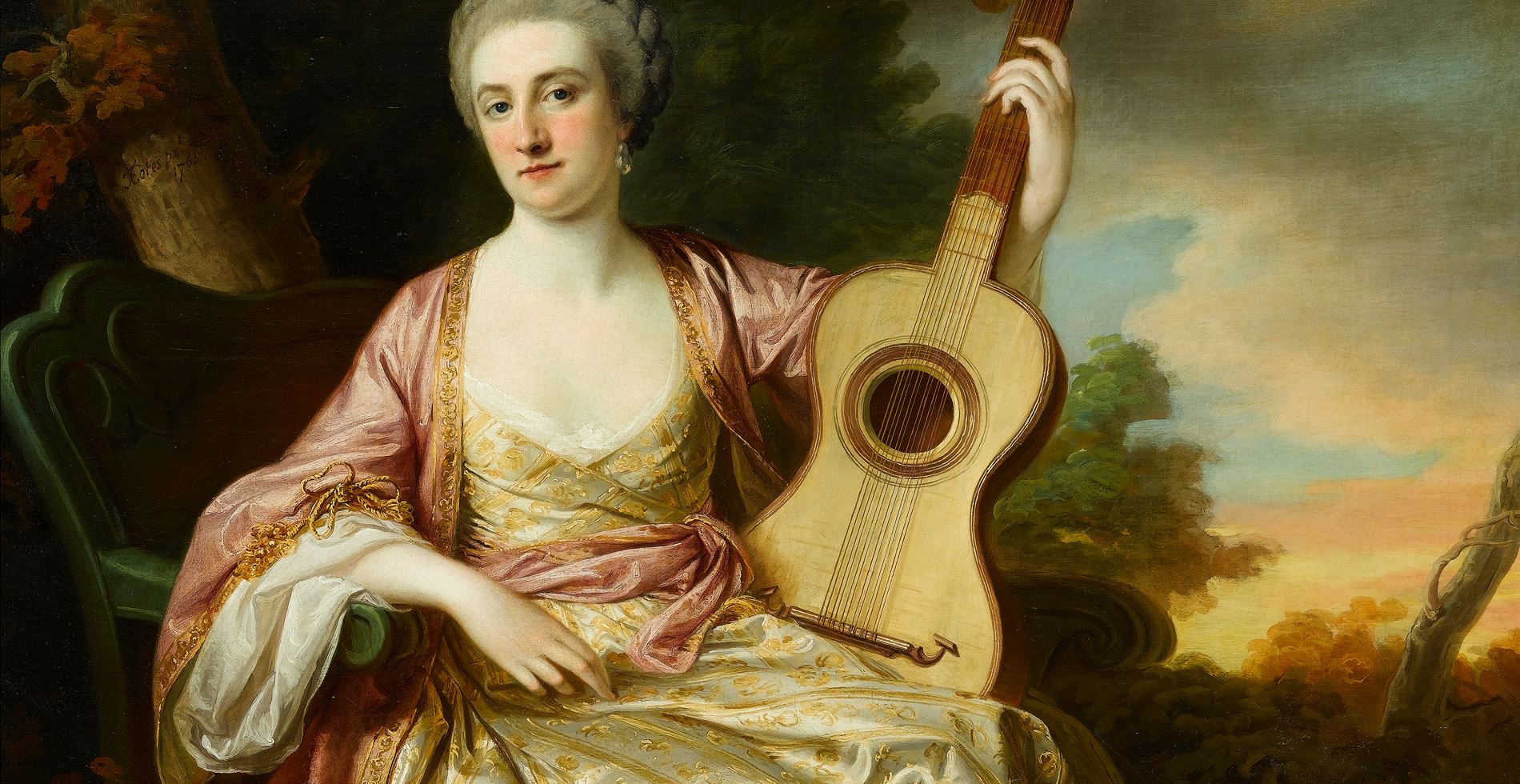
Set against a romanticised background,Maria Walpole sits stately and luxuriant, decked out in a rich white and gold dress with a pink gown. Her posture is open and confident, her gaze inviting and assured. Her delicately pale features, bathed in a soft light, lend her an air of elegance and unblemished beauty. In the slender fingers of her left hand she holds an early, six double course guitar. Of particular note is the exceptional detail given over to her dress. Francis Cotes excelled in representing costumes, which is superbly illustrated in the folds, reflections and differing textures of Maria’s garments.
The present painting is typical of Cotes’ portraits of the beautiful and fashionable ladies of English high society. In his Portrait of Alice Countess of Shipbrook, (Private Collection) his subject is again posed with a musical instrument, a reference to musical ability, considered to be a ladylike quality. In these two works and Elizabeth Lady Jones, the sitters are set against a landscape background, an allusion to the great estates from which they come. In all three works Cotes’ skill as a painter of drapery is in evidence, and the luxury he conveys naturally reflects the affluence of his sitters.
Described as ‘beauty itself’ by her uncle Horace Walpole (1717-1797), Maria Walpole was one of the great icons of the mid-eighteenth century, renowned for her good looks and lively wit.¹ Lady Mary Wortley Montagu (1689-1762) wrote of her in 1759, ‘I am not surprised at Lady Waldegrave’s good fortune. Beauty has a large prerogative’.² Indeed, her rise from illegitimate daughter to attaining the title, Her Royal Highness Duchess of Gloucester and Edinburgh, speaks of a remarkable and eventful life story, ‘who epitomized [sic] the often fractious vicissitudes within the court of George III’.³
Maria was born out of wedlock to Sir Edward Walpole (1706-1784) and his mistress Dorothy Clement, a milliner of humble origins from Darlington. Sir Edward’s father, Maria’s grandfather, was Sir Robert Walpole (1676-1745), considered to be the first Prime Minister of Great Britain, although the title did not formally exist then. Maria Walpole was brought up with her brother and two sisters at the family home at Englefield Green in Surrey. Her father led a retiring life in the country and, on coming of age, the girls’ introduction to society was left to their uncle Horace Walpole. Maria emerged as rival to the infamous society belle Maria Gunning, Countess of Coventry (1733-1760), whom Cotes also painted (fig. 3). Equally celebrated for her beauty, Gunning resolved to strike up a great alliance with Maria, prompting Horace Walpole to remark that Lady Coventry, ‘has made a friendship with my charming niece, to disguise her jealousy of the new Countess’s beauty’.⁴ The two ladies were seldom seen apart, cementing each other’s position as the epicentre of fashionable society to the extent that, according to Horace Walpole, they were mobbed in the Park by the admiring public. Horace Walpole was so captivated by these women that at a dinner at which they were both present, along with the Duchesses of Hamilton and Richmond and Lady Ailesbury, he commented, ‘A thousand years hence, when I begin to grow old, if that can ever be, I shall tell of that event, and tell young people how much handsomer the women of my time were than they will be then’.⁵
Horace took it upon himself to arrange Maria’s marriage. He successfully introduced her to James Waldegrave, 2nd Earl Waldegrave (1715-1763), a prominent member of George II’s (1683-1760) court and governor to the future George III (1738-1820). The couple married in May 1759 at Maria’s father’s house in Pall Mall, after which she acquired the title Countess Waldegrave. Twenty-one years her senior, the marriage was a surprising success and sealed the twenty-three year old’s status as a leading society figure in London. The couple had three daughters, Elizabeth Laura (1760-1816), Charlotte Maria (1761-1808) and Anna Horatia (1762-1801), who are famously depicted in Sir Joshua Reynolds’ (1723-1792) celebrated painting, The Ladies Waldegrave, which Horace Walpole commissioned.
Sadly, James Waldegrave died of smallpox four years later in April 1763 at his house in Albermarle Street. At the time, the Countess was convinced that she was pregnant with the Earl’s son but by August she was forced to concede otherwise, and surrendered her husband’s signet ring to her brother-in-law, recognizing him as the 3rd Earl Waldegrave. Horace Walpole described his niece’s reaction to becoming a widow, writing ‘She cried for two days to such a degree, that if she had been a fountain it must have stopped. Till yesterday she scarce eat enough to keep alive and looks accordingly’.⁶ A painting by Thomas Gainsborough (1727-1788) depicts Maria arrayed in mourning dress (fig. 4). Sombre in tone compared to the exuberance of the present portrait, Gainsborough’s painting depicts Maria wearing a black mourning dress, as required by convention. However, she retains a graceful allure and her hairstyle, jewellery, and other details of dress reflect ‘the young widow’s status as an acknowledged beauty at the forefront of current fashion and as someone obviously conscious of her position in society’.⁷
Maria was left a jointure of £1,000 per annum and charged with the care of her three daughters. Her uncle Horace hoped that with youth and beauty still on her side, ‘she may find as great a match and a younger lover’. As prophesied, she soon attracted the admiration of King George III’s brother, Prince William Henry, 1st Duke of Gloucester (1743-1805). Despite being eight years her junior, the couple were seemingly devoted to one another, as reported by Lady Sarah Bunbury, who said ‘The report of this week is that the King has forbid the D. of G. to speak to his pretty widow...He has given her fine pearl bracelets that cost £500 - that’s not for nothing surely?’⁸ The couple married in secret at Gloucester’s house in Pall Mall on 6th September, 1766, and did not tell the King until compelled to by Maria’s pregnancy in 1772. This infuriated the monarch and their marriage, and that of the Duke’s older brother, the Duke of Cumberland, to another widow of non-royal rank, led to the passing of the Royal Marriages Act, 1772. This required all descendants of George II to seek the Sovereign’s approval before marriage. Prince William’s union to Maria ruptured his close relationship with the King and Maria was never formally received at court as Duchess.
Due to mounting debts, the Duke and Duchess were forced into a self-imposed exile abroad, chiefly in Italy, and here their son Prince William Frederick, Duke of Gloucester and Edinburgh (1776-1834) was born. Maria had two further children with the Duke, Princess Sophia of Gloucester (1773-1844) and Princess Caroline Augusta Maria of Gloucester (1774-1775), who died aged nine months. The Duke and Duchess returned to England in 1777, by which stage the Duchess’s daughters were reaching a marriageable age. They were highly sought after and Maria occupied herself by supervising potential suitors. By 1780, the royal couple’s relationship began to deteriorate. The Duke embarked on an affair with the Duchess’s lady of the bedchamber, Lady Almeria Carpenter (1752-1809), by whom he had a daughter.⁹ By the 1790s, Prince William and Maria had virtually separated, largely facilitated by a dispute over their daughter’s education. In 1805, the Duke of Gloucester died. Maria then moved to Oxford Lodge, Brompton Road, where she died two years later at the age of seventy-one.
Portrait of Maria Walpole, Countess Waldegrave, Later H. R. H. Duchess of Gloucester and Edinburgh was painted two years after the death of her first husband, James Waldegrave. At the age of twenty-nine, she remains elegant and formidable. Unlike in Gainsborough’s painting she is no longer in mourning. Instead the twenty-nine year-old is portrayed ‘if not as “a maiden”, at least as a young, newly marriageable woman, still possessing considerable charm and beauty’.¹⁰ It is no surprise that, as anticipated by her uncle, she was soon to find another suitor, marrying the Duke of Gloucester a year after this portrait.
Cotes was the eldest child of Robert Cotes and brother of Samuel Cotes (1734-1818), a painter in miniature. He initially concentrated on portraits in pastel and crayon, under the tutelage of George Knapton (1698-1778). He was also an admirer of the Venetian artist Rosalba Carriera (1675-1757), an accomplished and popular Venetian Rococo painter, best known for her pastel work. Her example no doubt helped Cotes’ early work, although he employed stronger tones and bolder lines.
Cotes established himself as a highly fashionable painter, particularly after his crayon portraits of the Gunning sisters were frequently engraved, which enabled his work to reach a wider audience and thus gain much needed public recognition. By the 1770s, he was one of the most fashionable and sought after portrait painters in London.
After pushing crayon to its limits as a medium, although he was never to abandon it entirely, Cotes turned to oil painting as a means of developing his style in larger-scale works. In his most successful paintings, particularly those of the early 1760s, the oil paint is thinly applied, in imitation of his pastel technique, and imbued with charm, inviting comparisons with Allan Ramsay (1713-1784) and Reynolds. They have clarity and warmth and possess a remarkable attention to costume, as evident in the present work.
Around the mid-1760s, Cotes bought a large house on fashionable Cavendish Square, employed the drapery painter Peter Toms (c.1728-1777), which greatly increased his output, and took in the pastellist John Russell (1745-1806) as a pupil. In 1765, he became the director of the Society of Artists, with whom he had exhibited since 1760, and he was instrumental in setting up the Royal Academy of Arts in 1768. By this stage he was at the peak of his career, being one of the most important figures in the London art world and receiving praise and patronage from the royal family.
Portrait of Maria Walpole, Countess Waldegrave, Later H. R. H. Duchess of Gloucester and Edinburgh has an impressive provenance, having been passed down from Maria Walpole to her son Prince William, 2nd Duke of Gloucester, and remaining within the family for generations. It stands today as a fine example of Cotes’ accomplished work, and is a record of a formidable and intriguing woman, who rose from illegitimacy to become a princess of the royal family, enchanting society with her beauty and grace.
¹ Letter from Horace Walpole to Sir Horace Mann, Strawberry Hill, 9th September 1758.
² Letter from the Right Honourable Lady Mary Wortley Montagu to the Countess of Bute, 24th June 1759.
³ Piper, C., 'A Contribution to the Iconography of Maria Walpole (1736-1807): A Portrait by Nathaniel Dance (1748-1827)' in The British Art Journal, Volume XII, No. 2, 2011, p.9
⁴ Letter from Horace Walpole to George Montagu, Esq., 2nd June 1759.
⁵ Ibid.
⁶ Letter from Horace Walpole to George Montagu, 14 April 1763.
⁷ Piper, p.12.
⁸ Lady Sarah Bunbury to Lady Sausan O’Brien, 8th March 1766, The Life and Letters of Lady Sarah Lennox, 2 vols, ed. The Countess of Ilchester and Lord Stavordale (London, 1902), vol.1, p.189.
⁹ See Sphinx Fine Art inventory for a portrait of Lady Almeria Carpenter by Richard Cosway (1742-1821)
¹⁰ Piper, p. 12.
The sitter;
by descent to her son H.H. William, Duke of Gloucester and Edinburgh (1776-1834);
bequeathed to his wife, H.R.H. Mary, Duchess of Gloucester and Edinburgh (1776-1857), daughter of George III;
by descent to her nephew, Prince George, 2nd Duke of Cambridge (1819-1904);
thence by descent,
sale Bonham’s, London, 8 December 2004, lot 59;
where purchased by the previous owner.
Corey Piper, 'A Contribution to the Iconography of Maria Walpole (1736-1807): A Portrait by Nathaniel Dance (1748-1827)' in The British Art Journal, Volume XII, No. 2, 2011, p. 12 (illustrated).



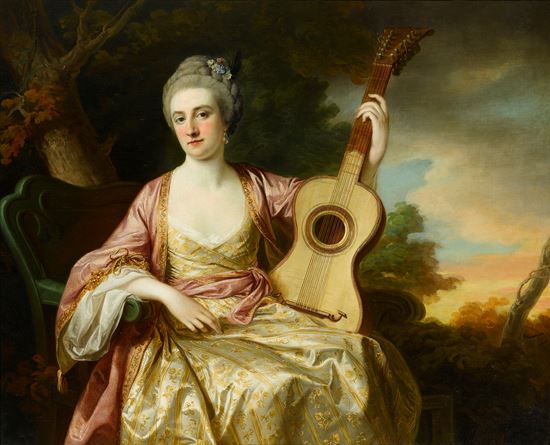
Set against a romanticised background,Maria Walpole sits stately and luxuriant, decked out in a rich white and gold dress with a pink gown. Her posture is open and confident, her gaze inviting and assured. Her delicately pale features, bathed in a soft light, lend her an air of elegance and unblemished beauty. In the slender fingers of her left hand she holds an early, six double course guitar. Of particular note is the exceptional detail given over to her dress. Francis Cotes excelled in representing costumes, which is superbly illustrated in the folds, reflections and differing textures of Maria’s garments.
The present painting is typical of Cotes’ portraits of the beautiful and fashionable ladies of English high society. In his Portrait of Alice Countess of Shipbrook, (Private Collection) his subject is again posed with a musical instrument, a reference to musical ability, considered to be a ladylike quality. In these two works and Elizabeth Lady Jones, the sitters are set against a landscape background, an allusion to the great estates from which they come. In all three works Cotes’ skill as a painter of drapery is in evidence, and the luxury he conveys naturally reflects the affluence of his sitters.
Described as ‘beauty itself’ by her uncle Horace Walpole (1717-1797), Maria Walpole was one of the great icons of the mid-eighteenth century, renowned for her good looks and lively wit.¹ Lady Mary Wortley Montagu (1689-1762) wrote of her in 1759, ‘I am not surprised at Lady Waldegrave’s good fortune. Beauty has a large prerogative’.² Indeed, her rise from illegitimate daughter to attaining the title, Her Royal Highness Duchess of Gloucester and Edinburgh, speaks of a remarkable and eventful life story, ‘who epitomized [sic] the often fractious vicissitudes within the court of George III’.³
Maria was born out of wedlock to Sir Edward Walpole (1706-1784) and his mistress Dorothy Clement, a milliner of humble origins from Darlington. Sir Edward’s father, Maria’s grandfather, was Sir Robert Walpole (1676-1745), considered to be the first Prime Minister of Great Britain, although the title did not formally exist then. Maria Walpole was brought up with her brother and two sisters at the family home at Englefield Green in Surrey. Her father led a retiring life in the country and, on coming of age, the girls’ introduction to society was left to their uncle Horace Walpole. Maria emerged as rival to the infamous society belle Maria Gunning, Countess of Coventry (1733-1760), whom Cotes also painted (fig. 3). Equally celebrated for her beauty, Gunning resolved to strike up a great alliance with Maria, prompting Horace Walpole to remark that Lady Coventry, ‘has made a friendship with my charming niece, to disguise her jealousy of the new Countess’s beauty’.⁴ The two ladies were seldom seen apart, cementing each other’s position as the epicentre of fashionable society to the extent that, according to Horace Walpole, they were mobbed in the Park by the admiring public. Horace Walpole was so captivated by these women that at a dinner at which they were both present, along with the Duchesses of Hamilton and Richmond and Lady Ailesbury, he commented, ‘A thousand years hence, when I begin to grow old, if that can ever be, I shall tell of that event, and tell young people how much handsomer the women of my time were than they will be then’.⁵
Horace took it upon himself to arrange Maria’s marriage. He successfully introduced her to James Waldegrave, 2nd Earl Waldegrave (1715-1763), a prominent member of George II’s (1683-1760) court and governor to the future George III (1738-1820). The couple married in May 1759 at Maria’s father’s house in Pall Mall, after which she acquired the title Countess Waldegrave. Twenty-one years her senior, the marriage was a surprising success and sealed the twenty-three year old’s status as a leading society figure in London. The couple had three daughters, Elizabeth Laura (1760-1816), Charlotte Maria (1761-1808) and Anna Horatia (1762-1801), who are famously depicted in Sir Joshua Reynolds’ (1723-1792) celebrated painting, The Ladies Waldegrave, which Horace Walpole commissioned.
Sadly, James Waldegrave died of smallpox four years later in April 1763 at his house in Albermarle Street. At the time, the Countess was convinced that she was pregnant with the Earl’s son but by August she was forced to concede otherwise, and surrendered her husband’s signet ring to her brother-in-law, recognizing him as the 3rd Earl Waldegrave. Horace Walpole described his niece’s reaction to becoming a widow, writing ‘She cried for two days to such a degree, that if she had been a fountain it must have stopped. Till yesterday she scarce eat enough to keep alive and looks accordingly’.⁶ A painting by Thomas Gainsborough (1727-1788) depicts Maria arrayed in mourning dress (fig. 4). Sombre in tone compared to the exuberance of the present portrait, Gainsborough’s painting depicts Maria wearing a black mourning dress, as required by convention. However, she retains a graceful allure and her hairstyle, jewellery, and other details of dress reflect ‘the young widow’s status as an acknowledged beauty at the forefront of current fashion and as someone obviously conscious of her position in society’.⁷
Maria was left a jointure of £1,000 per annum and charged with the care of her three daughters. Her uncle Horace hoped that with youth and beauty still on her side, ‘she may find as great a match and a younger lover’. As prophesied, she soon attracted the admiration of King George III’s brother, Prince William Henry, 1st Duke of Gloucester (1743-1805). Despite being eight years her junior, the couple were seemingly devoted to one another, as reported by Lady Sarah Bunbury, who said ‘The report of this week is that the King has forbid the D. of G. to speak to his pretty widow...He has given her fine pearl bracelets that cost £500 - that’s not for nothing surely?’⁸ The couple married in secret at Gloucester’s house in Pall Mall on 6th September, 1766, and did not tell the King until compelled to by Maria’s pregnancy in 1772. This infuriated the monarch and their marriage, and that of the Duke’s older brother, the Duke of Cumberland, to another widow of non-royal rank, led to the passing of the Royal Marriages Act, 1772. This required all descendants of George II to seek the Sovereign’s approval before marriage. Prince William’s union to Maria ruptured his close relationship with the King and Maria was never formally received at court as Duchess.
Due to mounting debts, the Duke and Duchess were forced into a self-imposed exile abroad, chiefly in Italy, and here their son Prince William Frederick, Duke of Gloucester and Edinburgh (1776-1834) was born. Maria had two further children with the Duke, Princess Sophia of Gloucester (1773-1844) and Princess Caroline Augusta Maria of Gloucester (1774-1775), who died aged nine months. The Duke and Duchess returned to England in 1777, by which stage the Duchess’s daughters were reaching a marriageable age. They were highly sought after and Maria occupied herself by supervising potential suitors. By 1780, the royal couple’s relationship began to deteriorate. The Duke embarked on an affair with the Duchess’s lady of the bedchamber, Lady Almeria Carpenter (1752-1809), by whom he had a daughter.⁹ By the 1790s, Prince William and Maria had virtually separated, largely facilitated by a dispute over their daughter’s education. In 1805, the Duke of Gloucester died. Maria then moved to Oxford Lodge, Brompton Road, where she died two years later at the age of seventy-one.
Portrait of Maria Walpole, Countess Waldegrave, Later H. R. H. Duchess of Gloucester and Edinburgh was painted two years after the death of her first husband, James Waldegrave. At the age of twenty-nine, she remains elegant and formidable. Unlike in Gainsborough’s painting she is no longer in mourning. Instead the twenty-nine year-old is portrayed ‘if not as “a maiden”, at least as a young, newly marriageable woman, still possessing considerable charm and beauty’.¹⁰ It is no surprise that, as anticipated by her uncle, she was soon to find another suitor, marrying the Duke of Gloucester a year after this portrait.
Cotes was the eldest child of Robert Cotes and brother of Samuel Cotes (1734-1818), a painter in miniature. He initially concentrated on portraits in pastel and crayon, under the tutelage of George Knapton (1698-1778). He was also an admirer of the Venetian artist Rosalba Carriera (1675-1757), an accomplished and popular Venetian Rococo painter, best known for her pastel work. Her example no doubt helped Cotes’ early work, although he employed stronger tones and bolder lines.
Cotes established himself as a highly fashionable painter, particularly after his crayon portraits of the Gunning sisters were frequently engraved, which enabled his work to reach a wider audience and thus gain much needed public recognition. By the 1770s, he was one of the most fashionable and sought after portrait painters in London.
After pushing crayon to its limits as a medium, although he was never to abandon it entirely, Cotes turned to oil painting as a means of developing his style in larger-scale works. In his most successful paintings, particularly those of the early 1760s, the oil paint is thinly applied, in imitation of his pastel technique, and imbued with charm, inviting comparisons with Allan Ramsay (1713-1784) and Reynolds. They have clarity and warmth and possess a remarkable attention to costume, as evident in the present work.
Around the mid-1760s, Cotes bought a large house on fashionable Cavendish Square, employed the drapery painter Peter Toms (c.1728-1777), which greatly increased his output, and took in the pastellist John Russell (1745-1806) as a pupil. In 1765, he became the director of the Society of Artists, with whom he had exhibited since 1760, and he was instrumental in setting up the Royal Academy of Arts in 1768. By this stage he was at the peak of his career, being one of the most important figures in the London art world and receiving praise and patronage from the royal family.
Portrait of Maria Walpole, Countess Waldegrave, Later H. R. H. Duchess of Gloucester and Edinburgh has an impressive provenance, having been passed down from Maria Walpole to her son Prince William, 2nd Duke of Gloucester, and remaining within the family for generations. It stands today as a fine example of Cotes’ accomplished work, and is a record of a formidable and intriguing woman, who rose from illegitimacy to become a princess of the royal family, enchanting society with her beauty and grace.
¹ Letter from Horace Walpole to Sir Horace Mann, Strawberry Hill, 9th September 1758.
² Letter from the Right Honourable Lady Mary Wortley Montagu to the Countess of Bute, 24th June 1759.
³ Piper, C., 'A Contribution to the Iconography of Maria Walpole (1736-1807): A Portrait by Nathaniel Dance (1748-1827)' in The British Art Journal, Volume XII, No. 2, 2011, p.9
⁴ Letter from Horace Walpole to George Montagu, Esq., 2nd June 1759.
⁵ Ibid.
⁶ Letter from Horace Walpole to George Montagu, 14 April 1763.
⁷ Piper, p.12.
⁸ Lady Sarah Bunbury to Lady Sausan O’Brien, 8th March 1766, The Life and Letters of Lady Sarah Lennox, 2 vols, ed. The Countess of Ilchester and Lord Stavordale (London, 1902), vol.1, p.189.
⁹ See Sphinx Fine Art inventory for a portrait of Lady Almeria Carpenter by Richard Cosway (1742-1821)
¹⁰ Piper, p. 12.
The sitter;
by descent to her son H.H. William, Duke of Gloucester and Edinburgh (1776-1834);
bequeathed to his wife, H.R.H. Mary, Duchess of Gloucester and Edinburgh (1776-1857), daughter of George III;
by descent to her nephew, Prince George, 2nd Duke of Cambridge (1819-1904);
thence by descent,
sale Bonham’s, London, 8 December 2004, lot 59;
where purchased by the previous owner.
Corey Piper, 'A Contribution to the Iconography of Maria Walpole (1736-1807): A Portrait by Nathaniel Dance (1748-1827)' in The British Art Journal, Volume XII, No. 2, 2011, p. 12 (illustrated).
You may also like
(London 1726 - Richmond 1770)
(London 1726 - Richmond 1770)
(London 1726 - Richmond 1770)