Count Amadeo Preziosi
(Valetta 1816 - Istanbul 1882)
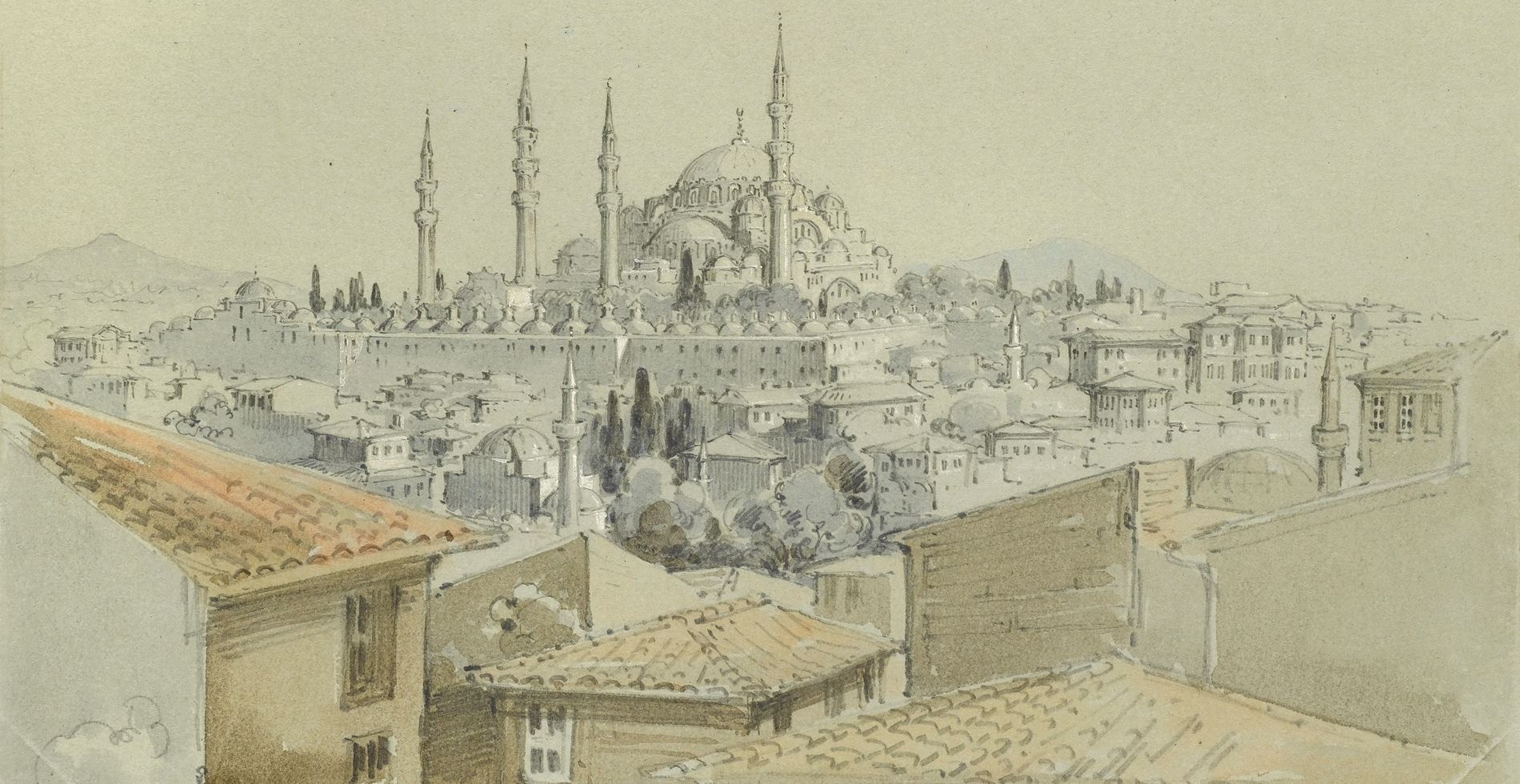
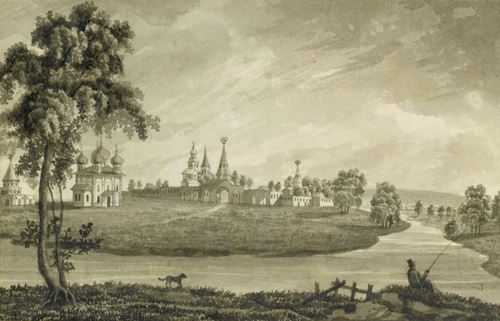
View of the Süleymaniye Mosque over Rooftops
 contact
ount Amadeo Preziosi
(Valetta 1816 - Istanbul 1882)
View of the Süleymaniye Mosque over Rooftops
signed and inscribed ‘Soulimanie/Preziosi’ (lower right)
pencil and watercolour heightened with white
16 x 25 cm (6¼ x 9¾ in)
 +44 20 7313 8040
Count Amadeo Preziosi has unusually chosen to depict the Süleymaniye mosque from over the rooftops of Istanbul rather than from across the Golden Horn. With his extensive knowledge of the city, Preziosi may have been trying to move away from the ‘typical’ nineteenth-century views of Istanbul, by finding an alternative - albeit equally exquisite - viewpoint. He has reserved the earthy tones of the colour wash exclusively for the foreground and the terracotta roof tiles; however, by applying an almost monochromatic tone to the mid-ground and background, Preziosi succeeded in making the Süleymaniye Mosque appear even more monumental. It therefore stands out even more against the Istanbul skyline.
Like many of his contemporaries, Preziosi had been lured to the exotic city of Istanbul. Though his initial intention was to remain in the city for only a short while, and despite his father’s requests for him to return to Malta to pursue a ‘respectable’ career, Preziosi became so absorbed with the city that he ended up settling there, and married an Istanbul Greek woman with whom he had four children. His paintings sold well to local and foreign customers alike, who hung them on the walls of their grand houses and palaces. During his time in Istanbul Preziosi also became court painter to Sultan Abdul Hamid II (1842-1918).
Preziosi’s love of the city and its people is represented in his numerous works that catalogue daily life in the city, such as a street seller, a dancing bear or a woman filling her water jar at a street fountain. Through his eyes we explore every nook and angle: from the tiny back street shops, the coffee houses, hamams and places of worship, to views across the blue waters of the Bosphorus with its caïques, pavilions and palaces.
Preziosi was descended from a family who had migrated from Corsica to Malta in the seventeenth century, and had been awarded a title by the King of Sicily. Preziosi was born in Valetta on 2 December 1816, and spent his childhood and youth in Malta. His father Count Gio Francois was an eminent figure in Malta.
Preziosi was educated by private tutors, and his passion for drawing and painting began as a child. Although he studied law in accordance with his parents’ wishes, he eventually abandoned this profession to devote himself to painting, first entering the studio of Giuseppe Hyzler (1793-1858), and subsequently going to France to complete his art education at the Paris Academy of Fine Arts. This was a time when European painters were flocking to the Gateway to the East, as Istanbul was known, and under this influence Preziosi packed up his paints and brushes and set out from Malta in 1842, travelling first to Italy and then to Istanbul.
Despite his father’s entreaties Preziosi refused to return to Malta, where the other members of his family followed ‘respectable’ careers as doctors, merchants and lawyers. He remained loyal to the passionate loves of his life: Istanbul and painting. As well as his mother tongue of Italian, Preziosi spoke French, Greek, English and Turkish. Preziosi lived with his family for many years in Beyoglu, at number 14 Hamalbasi Sokak near the present British Consulate.
In 1882, at the age of 65, he accidentally dropped his rifle whilst on a hunt. The gun fired, causing fatal injuries from which Preziosi died the following day. Preziosi’s paintings were exhibited in Paris and London in 1858, 1863 and 1867.



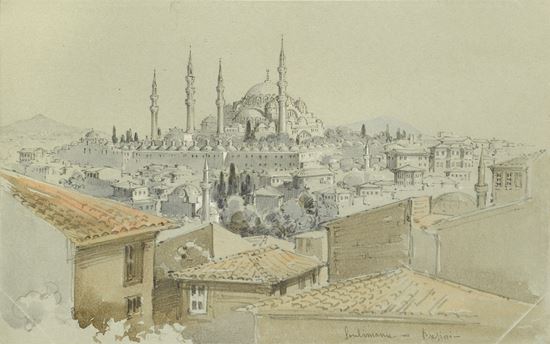
Count Amadeo Preziosi has unusually chosen to depict the Süleymaniye mosque from over the rooftops of Istanbul rather than from across the Golden Horn. With his extensive knowledge of the city, Preziosi may have been trying to move away from the ‘typical’ nineteenth-century views of Istanbul, by finding an alternative - albeit equally exquisite - viewpoint. He has reserved the earthy tones of the colour wash exclusively for the foreground and the terracotta roof tiles; however, by applying an almost monochromatic tone to the mid-ground and background, Preziosi succeeded in making the Süleymaniye Mosque appear even more monumental. It therefore stands out even more against the Istanbul skyline.
Like many of his contemporaries, Preziosi had been lured to the exotic city of Istanbul. Though his initial intention was to remain in the city for only a short while, and despite his father’s requests for him to return to Malta to pursue a ‘respectable’ career, Preziosi became so absorbed with the city that he ended up settling there, and married an Istanbul Greek woman with whom he had four children. His paintings sold well to local and foreign customers alike, who hung them on the walls of their grand houses and palaces. During his time in Istanbul Preziosi also became court painter to Sultan Abdul Hamid II (1842-1918).
Preziosi’s love of the city and its people is represented in his numerous works that catalogue daily life in the city, such as a street seller, a dancing bear or a woman filling her water jar at a street fountain. Through his eyes we explore every nook and angle: from the tiny back street shops, the coffee houses, hamams and places of worship, to views across the blue waters of the Bosphorus with its caïques, pavilions and palaces.
Preziosi was descended from a family who had migrated from Corsica to Malta in the seventeenth century, and had been awarded a title by the King of Sicily. Preziosi was born in Valetta on 2 December 1816, and spent his childhood and youth in Malta. His father Count Gio Francois was an eminent figure in Malta.
Preziosi was educated by private tutors, and his passion for drawing and painting began as a child. Although he studied law in accordance with his parents’ wishes, he eventually abandoned this profession to devote himself to painting, first entering the studio of Giuseppe Hyzler (1793-1858), and subsequently going to France to complete his art education at the Paris Academy of Fine Arts. This was a time when European painters were flocking to the Gateway to the East, as Istanbul was known, and under this influence Preziosi packed up his paints and brushes and set out from Malta in 1842, travelling first to Italy and then to Istanbul.
Despite his father’s entreaties Preziosi refused to return to Malta, where the other members of his family followed ‘respectable’ careers as doctors, merchants and lawyers. He remained loyal to the passionate loves of his life: Istanbul and painting. As well as his mother tongue of Italian, Preziosi spoke French, Greek, English and Turkish. Preziosi lived with his family for many years in Beyoglu, at number 14 Hamalbasi Sokak near the present British Consulate.
In 1882, at the age of 65, he accidentally dropped his rifle whilst on a hunt. The gun fired, causing fatal injuries from which Preziosi died the following day. Preziosi’s paintings were exhibited in Paris and London in 1858, 1863 and 1867.
You may also like
(Valetta 1816 - Istanbul 1882)
(Valetta 1816 - Istanbul 1882)
(Valetta 1816 - Istanbul 1882)