Adriaen van de Velde
(Amsterdam 1636 - Amstedam 1672)
Pastoral Landscape with Sheep and Peasants
 contact
driaen van de Velde
(Amsterdam 1636 - Amstedam 1672)
Pastoral Landscape with Sheep and Peasants
oil on panel
20.3 x 16.5 cm (8 x 6½ in)
 +44 20 7313 8040
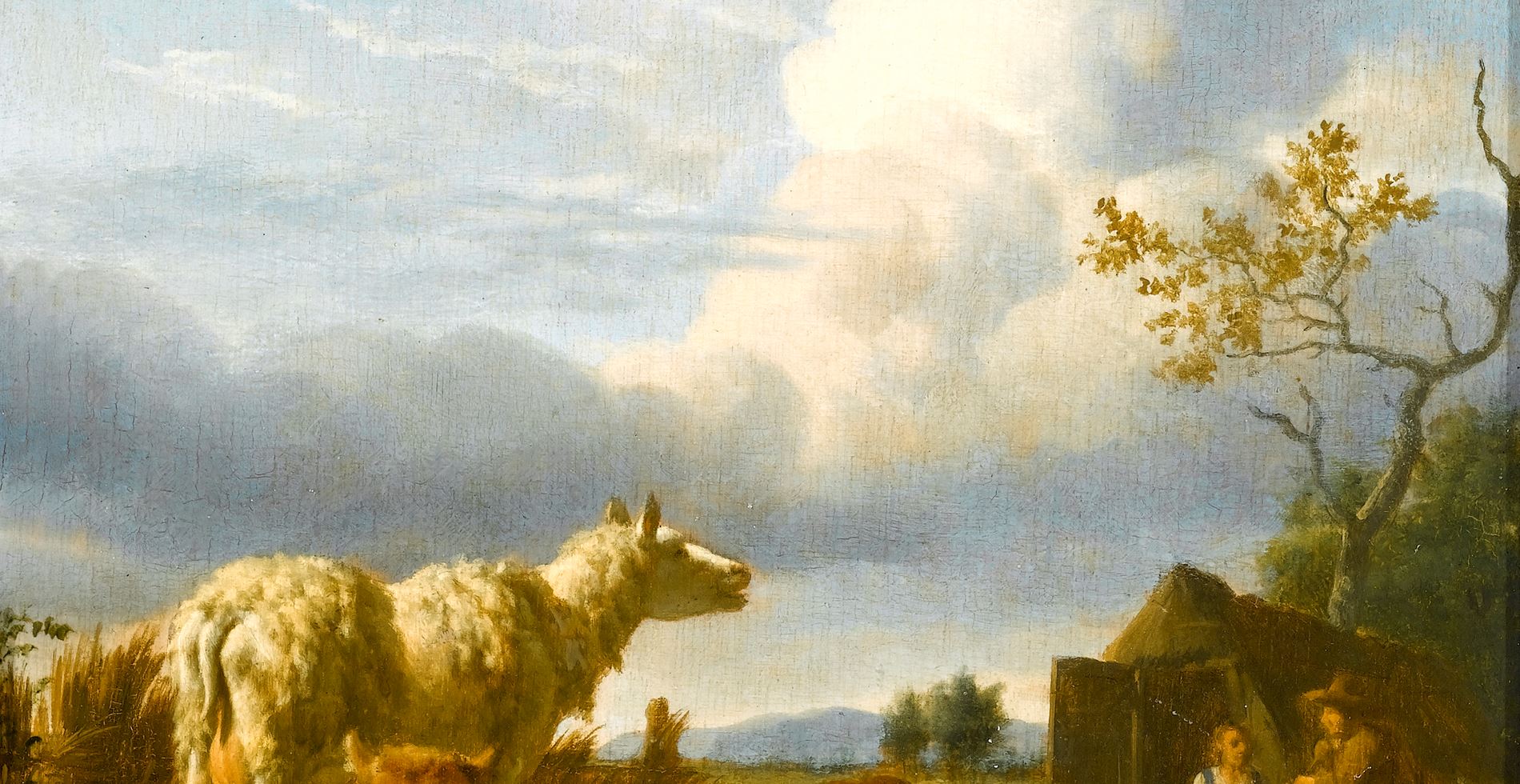
This sunlit pastoral landscape showcases Adriaen van de Velde’s intense skill, one which he demonstrated throughout his career, for depicting animals. In his Pastoral Landscape with Sheep and Peasants, van de Velde focuses on the two sheep which dominate the foreground of this narrow composition. They face in opposite directions, with one standing, whilst the other settles placidly on its haunches. By employing contrasting poses, van de Velde provides a more rounded and complete study of the animals.
One of the sheep stares out directly at the viewer, further focusing attention on the pair. Beyond, outside a small thatched hut, two peasants sit chatting in the sunshine, while a third sheep, fully shorn, grazes nearby. From the expanse of blue sky, animated by the gentle billowing of soft white clouds, falls a shaft of light, suffusing the sheep in a warm golden glow. This warmth reflects the influence of Dutch Italianate painters, such as Nicholaes Berchem (1620-1683) and Jan Asselijn (after 1610-1652) although there is no evidence to suggest that van de Velde himself visited Italy.
When the present work was in the collection of the Earl of Plymouth, it is recorded as being part of a pair. The second work shows a sheep with two lambs, as well as a cow, and so again the focus is not only on an accurate depiction, but a varied one.¹ This second work is signed and dated, and therefore we can date Pastoral Landscape with Sheep and Peasants to 1661.
The focus on the accurate depiction of animals is a recurring theme throughout van de Velde’s career. According to the biographer Arnold Houbraken (1660-1719), van de Velde went ‘into the field’ daily to draw animals and landscapes; the results of such meticulous study are clearly evident in paintings such as the present work, or the National Gallery’s A Goat and a Kid.²
Van de Velde was born in Amsterdam and trained under his father, the great marine artist Willem van de Velde I (c. 1611-1693). However, unlike his father and his brother, Willem van de Velde II (1633-1707), Adriaen did not incline towards marine painting, and so he was sent to Haarlem to complete his training with Jan Wijnants (c. 1635-1684), although he was to spend the majority of his career in Amsterdam. However, it was the work of Paulus Potter (1625-1654), rather than Wijnants, who was to have the biggest influence on van de Velde’s art. His work is dominated by expertly observed and brilliantly rendered depictions of farmyard animals, of which the present work is a fine example, although as his career progressed, he started to depict more large-scale and panoramic works. He frequently contributed staffage to the works of artists such as Jacob van Ruisdael (c.1628-1682) and Meindert Hobbema (1638-1709), and he was also a brilliant etcher.
¹ For an illustration see The Hoogsteder Exhibition of Dutch Landscapes, Hoogsteder & Hoogsteder, The Hague, 1991, cat no. 38.
² Houbraken, A., De groote Schouburgh der Nederlantsche Konstschilders en Schilderessen, (1753), vol. II, p. 90.
Hon. Henry Windsor, London, 1834;
Anonymous sale, Paris, Tajan, March 31, 1995, lot 114;
with Galleria Luigi Caretto, 1995;
Anonymous sale, Vienna, Dorotheum, March 4, 1997, lot 137, unsold;
Private Collection, France;
with Salomon Lilian, Amsterdam, 1998;
Private collection, USA.
John Smith, A Catalogue Raisonné of the Works of the Most Eminent Dutch, Flemish, and French Painters, vol. 5, p. 222, no.157;
Cornelis Hofstede de Groot, A Catalogue Raisonné of the Works of the Most Eminent Dutch Painters of the Seventeenth Century Based on the Work of John Smith, vol. 4, p. 550, no. 325;
Meesterlijk Vee. Nederlandse veeschilders 1600-1900, exh. cat. (Dordrechts Museum, Dordrecht 1988, Fries Museum, Leeuwarden, 1988-1989), p.173;
The Hoogsteder Exhibition of Dutch Landscape exh. cat. (Galerie Hoogsteder & Hoogsteder, The Hague, 1991), p. 122;
Marietta Frensemeier, Studien zu Adriaen van de Velde (1636-1672), (Shaker Verlag, Aachen,2001), pp. 48, 156, 235, cat no. 65, fig. 37.



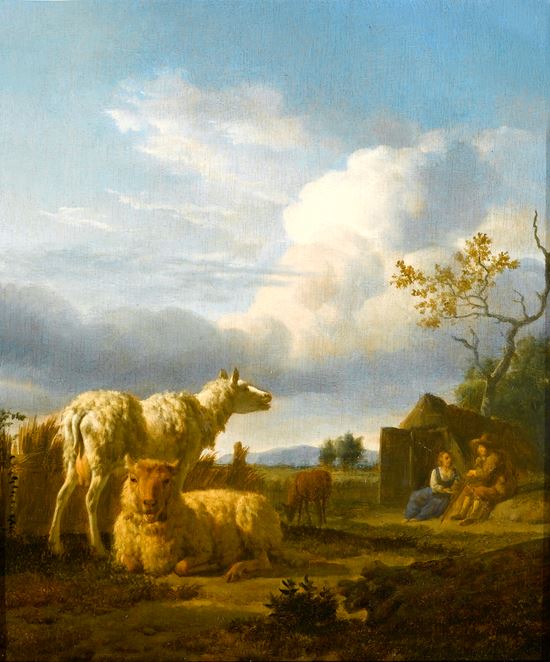
This sunlit pastoral landscape showcases Adriaen van de Velde’s intense skill, one which he demonstrated throughout his career, for depicting animals. In his Pastoral Landscape with Sheep and Peasants, van de Velde focuses on the two sheep which dominate the foreground of this narrow composition. They face in opposite directions, with one standing, whilst the other settles placidly on its haunches. By employing contrasting poses, van de Velde provides a more rounded and complete study of the animals.
One of the sheep stares out directly at the viewer, further focusing attention on the pair. Beyond, outside a small thatched hut, two peasants sit chatting in the sunshine, while a third sheep, fully shorn, grazes nearby. From the expanse of blue sky, animated by the gentle billowing of soft white clouds, falls a shaft of light, suffusing the sheep in a warm golden glow. This warmth reflects the influence of Dutch Italianate painters, such as Nicholaes Berchem (1620-1683) and Jan Asselijn (after 1610-1652) although there is no evidence to suggest that van de Velde himself visited Italy.
When the present work was in the collection of the Earl of Plymouth, it is recorded as being part of a pair. The second work shows a sheep with two lambs, as well as a cow, and so again the focus is not only on an accurate depiction, but a varied one.¹ This second work is signed and dated, and therefore we can date Pastoral Landscape with Sheep and Peasants to 1661.
The focus on the accurate depiction of animals is a recurring theme throughout van de Velde’s career. According to the biographer Arnold Houbraken (1660-1719), van de Velde went ‘into the field’ daily to draw animals and landscapes; the results of such meticulous study are clearly evident in paintings such as the present work, or the National Gallery’s A Goat and a Kid.²
Van de Velde was born in Amsterdam and trained under his father, the great marine artist Willem van de Velde I (c. 1611-1693). However, unlike his father and his brother, Willem van de Velde II (1633-1707), Adriaen did not incline towards marine painting, and so he was sent to Haarlem to complete his training with Jan Wijnants (c. 1635-1684), although he was to spend the majority of his career in Amsterdam. However, it was the work of Paulus Potter (1625-1654), rather than Wijnants, who was to have the biggest influence on van de Velde’s art. His work is dominated by expertly observed and brilliantly rendered depictions of farmyard animals, of which the present work is a fine example, although as his career progressed, he started to depict more large-scale and panoramic works. He frequently contributed staffage to the works of artists such as Jacob van Ruisdael (c.1628-1682) and Meindert Hobbema (1638-1709), and he was also a brilliant etcher.
¹ For an illustration see The Hoogsteder Exhibition of Dutch Landscapes, Hoogsteder & Hoogsteder, The Hague, 1991, cat no. 38.
² Houbraken, A., De groote Schouburgh der Nederlantsche Konstschilders en Schilderessen, (1753), vol. II, p. 90.
Hon. Henry Windsor, London, 1834;
Anonymous sale, Paris, Tajan, March 31, 1995, lot 114;
with Galleria Luigi Caretto, 1995;
Anonymous sale, Vienna, Dorotheum, March 4, 1997, lot 137, unsold;
Private Collection, France;
with Salomon Lilian, Amsterdam, 1998;
Private collection, USA.
John Smith, A Catalogue Raisonné of the Works of the Most Eminent Dutch, Flemish, and French Painters, vol. 5, p. 222, no.157;
Cornelis Hofstede de Groot, A Catalogue Raisonné of the Works of the Most Eminent Dutch Painters of the Seventeenth Century Based on the Work of John Smith, vol. 4, p. 550, no. 325;
Meesterlijk Vee. Nederlandse veeschilders 1600-1900, exh. cat. (Dordrechts Museum, Dordrecht 1988, Fries Museum, Leeuwarden, 1988-1989), p.173;
The Hoogsteder Exhibition of Dutch Landscape exh. cat. (Galerie Hoogsteder & Hoogsteder, The Hague, 1991), p. 122;
Marietta Frensemeier, Studien zu Adriaen van de Velde (1636-1672), (Shaker Verlag, Aachen,2001), pp. 48, 156, 235, cat no. 65, fig. 37.
You may also like
(Amsterdam 1636 - Amstedam 1672)
(Amsterdam 1636 - Amstedam 1672)
(Amsterdam 1636 - Amstedam 1672)